

E41: Marketing, Content, AI, and Websites in 2026! With Belle White
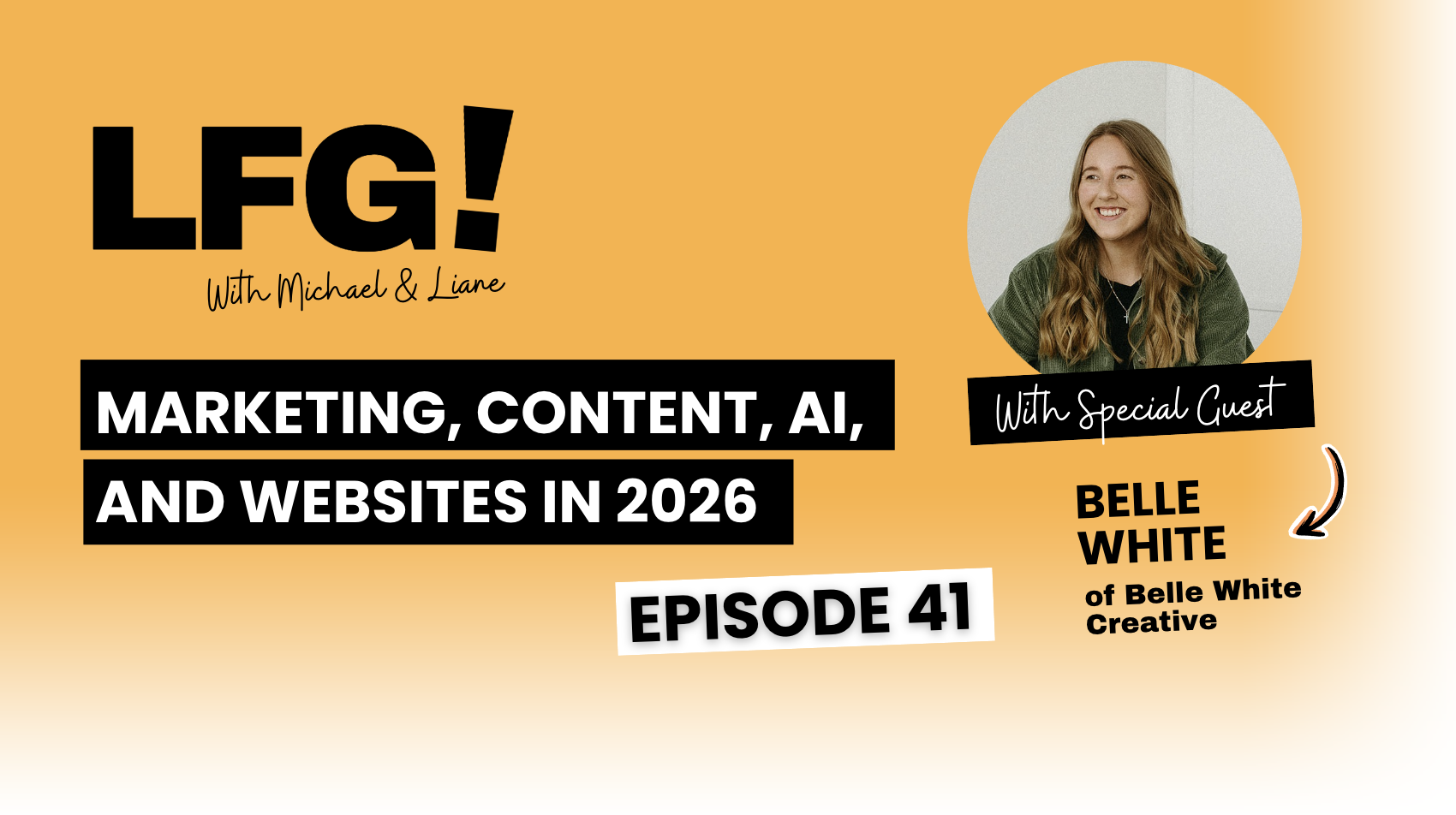
Hosts: Michael Hyam and Liane Caruso
Guests: Belle White, Website Designer and Copywriter at Belle White Creative
In a recent episode of the LFG Podcast, we sat down with Belle White, website designer and copywriter at Belle White Creative, to discuss the evolving landscape of marketing, content creation, and personal branding heading into 2026.
Belle’s unique perspective as both a creator and someone deeply embedded in the franchise community provided valuable insights for business owners, marketers, and content creators alike.
Podcast Summary: Belle White Creative Shares 2026 Trends and Insights Around Marketing, AI, Content, and Websites.
The Rise of Perspective-Based Content
According to Belle, one of the most significant shifts we’re seeing is that perspective is no longer optional—it’s essential. Generic content simply isn’t cutting through the noise anymore.
“You can’t just post a quote about entrepreneurship and have it resonate,” Belle explains. “You can’t just share your personal life and what it taught you about business using the same formulas everyone else uses. People need to hear your unique voice and experience.”
With AI-generated content becoming ubiquitous, the human element (your specific insights, experiences, and viewpoint) has become the differentiator. Readers and audiences can now generate generic how-to content themselves, which means content creators must go deeper, offering perspectives grounded in real experience.
Short, Long-Form Content is Winning
Belle identifies an interesting trend she calls “short, long form content” that’s substantial enough to provide real value but digestible enough to hold attention.
This includes:
- YouTube videos
- Substack newsletters
- Blog posts
- LinkedIn articles
- Podcasts
This format allows creators to share deeper insights and perspectives while supporting answer engine optimization (AEO). Having these longer-form pieces distributed across multiple platforms helps establish authority and improves discoverability in AI search tools.
Understanding Your Role with AI Tools
One of Belle’s most important messages centers on intentionality with AI tools: We get to decide when and how we use these tools.
“It feels really simple to say,” Belle admits, “but you do get to control when you think about the answer or when you Google it. So many of us are defaulting to things, as opposed to really realizing that we get to decide when and how these things are used.”
Her concern isn’t that AI will replace human expertise, but that people might take themselves out of the equation. A marketing novice using AI to build a complete marketing plan might miss crucial elements: prioritization, execution strategy, and the decades of experience that inform good decision-making.
The key is using AI as a tool that helps you work faster or more efficiently while maintaining your role as the strategist, decision-maker, and creative director of your work.
Simple Ways to Improve Answer Engine Optimization (AEO)
Belle shared several practical strategies for improving how AI search tools find and present your business information:
Start by Auditing What’s Already There
Type your business name or key questions about your services into AI tools like ChatGPT, Claude, or Microsoft Copilot. See what information appears, where it’s being pulled from, and whether it’s accurate and up-to-date.
Get Your Social Profiles Right
Social media platforms are a major source for answer engines. Belle’s advice:
- Use clear, simple language describing exactly what you do and who you serve
- Maintain consistent messaging across all platforms
- Focus on clarity first, then differentiation
- Link your social profiles to your website and vice versa
“It’s weird how few businesses focus on clarity on their websites and socials, especially profiles,” Belle notes. “That has actually become super valuable—it’s kind of a superpower to just be super clear across all your social platforms.”
Create an FAQ Page
This is one of the easiest and most effective changes you can make. Centralize all your frequently asked questions on one clearly labeled FAQ page. Answer engines frequently pull from these pages when responding to queries about your business or industry.
Write Human-Focused Blog Content
Forget the jargon and SEO keyword stuffing. Write like you talk. Focus on:
- Perspective-driven content, not just how-to guides
- Niche questions specific to your industry or brand
- Detailed answers that sound conversational
- Content that can be easily parsed and cited by AI tools
Belle emphasizes that generic how-to content is no longer valuable since anyone can generate it with AI. Instead, share specific insights and experiences that only you can provide.
Personal Branding in the AI Era
Perhaps the most refreshing perspective Belle offers is about personal branding: People just care about you as a person.
“I think people kind of just care about you as a person,” Belle says. “It doesn’t have to lean to a lesson or some kind of insight into something professional or productive.”
She challenges the common LinkedIn formula of turning every personal moment into a business lesson. Instead, she advocates for authenticity—sharing things you genuinely care about because you care about them, not because they need to tie back to business value.
This approach recognizes that business relationships are built on human connections. People do business with those they know, like, and trust, and that trust often comes from seeing someone as a complete person, not just a professional persona.
Productivity Systems That Actually Work
Belle shared two organizational systems that keep her efficient and help her maintain excellent client relationships:
Morning Routine Before Reactive Work
Rather than starting the day by checking email and responding to urgent matters,
Belle follows a short checklist:
- 5-10 minutes engaging on LinkedIn
- Sharing content to Pinterest (20 seconds)
- Personal time (Bible reading, coffee)
This 15-20 minute routine helps her ease into work mode and makes reactive tasks feel less stressful. “It signals to my brain, we’re problem solving, we’re on,” she explains.
The Eight-Folder Email System
Belle organizes her inbox using eight folders:
- Accounting – Anything money-related
- Business – Business development and general business matters
- Client – With subfolders for current client projects
- Dealt With – Her favorite folder for clearing the inbox while keeping things searchable
- Discovery – For discovery and prospecting work
- Events – Webinars, conferences, and outward-facing activities
- Good Stuff – Kind comments, great results, inspiration to revisit
- Personal – Personal matters that end up in the business inbox
The “Dealt With” folder alone is game-changing, allowing you to clear your inbox without deleting emails you might need to reference later.
Looking Ahead to 2026
As we head into 2026, Belle’s insights remind us that while tools and platforms evolve, the fundamentals remain constant: clear communication, genuine human connection, and strategic thinking matter more than ever.
The businesses and professionals who will thrive are those who leverage AI and new technologies to enhance their work while maintaining their unique perspective, voice, and human touch. They’ll focus on creating meaningful content, building authentic relationships, and staying organized enough to deliver exceptional experiences for their clients and audiences.
Ready to optimize your website and content strategy for 2026? Belle is hosting a free webinar on Answer Engine Optimization on January 8th, 2026.
Listen to the episode now to hear more from Belle and the LFG Podcast team!

KEEP LEARNING FROM FRANCHISE ASSEMBLY

