


E38: Franchisee-First Marketing: With RocketBarn Marketing
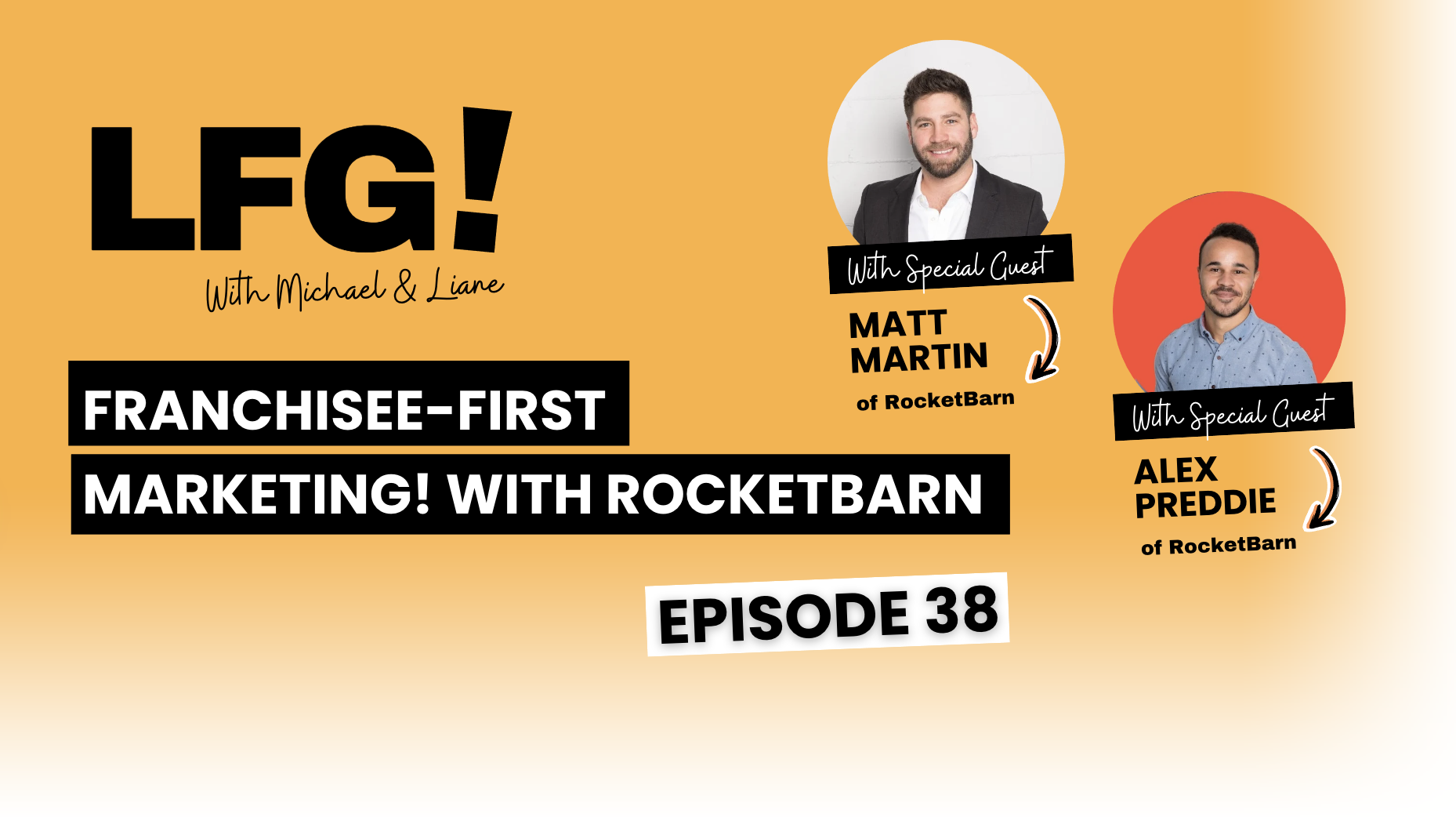
Hosts: Michael Hyam and Liane Caruso
Guests: Matt Martin, CEO & Alex Preddie, Director of Sales & Marketing of RocketBarn
Matt Martin (CEO) and Alex Preddie (Director of Sales and Marketing) from RocketBarn Marketing shared their evolving approach to franchise marketing — one that puts franchisees at the center of everything they do.
After 15 years as a digital marketing agency and four years of deep focus on franchising, Rocket Barn recently unveiled a rebrand that reflects their commitment to the space.
The new look features a unified “RocketBarn” wordmark (no more confusion about two separate words) and a distinctive burnt orange color scheme that sets them apart from the typical blue-and-white marketing agency palette.
But the rebrand goes deeper than aesthetics. It signals Rocket Barn’s expansion into the U.S. market with a new Nashville headquarters and strategic hires who bring valuable franchise operations experience to the team.
Podcast Summary: The Franchisee-First Marketing Approach From The Team at RocketBarn Marketing
What “Franchisee-First” Really Means
The phrase “franchisee-first marketing” gets thrown around a lot in the industry, but Rocket Barn has built a specific framework around it centered on their Franchise Marketing Advisor (FMA) role.
“It’s not just about strong customer service,” Matt explains. “It’s about becoming an extension of the team to a small business owner who’s doing a million different things.”
Their FMAs are trained not only as digital marketing experts but also in the unique language and dynamics of franchising. They go through specific certifications to understand the franchisor-franchisee relationship and can navigate the complexities that come with it.
This approach recognizes that every franchisee is different. Some want to dive deep into strategy and details; others prefer a trusted advisor who can simply tell them how things are going and what adjustments to make. The key is having someone who can adapt to those needs while maintaining alignment with franchisor guidelines.
Navigating AI and SEO: What Franchisees Need to Know
When it comes to AI’s impact on SEO, Alex offers reassuring news: “If you were doing well before, chances are you are still doing well today.”
For local searches with high intent—like “plumber near me” or “contractor in my area”—AI hasn’t dramatically changed the game. Google still displays the traditional map pack, ads, and organic listings that users expect.
The real insight? SEO has always been about the same fundamentals. Google and other search engines have simply gotten better at identifying shortcuts and rewarding genuine quality content.
“It’s really always been the same game with the same rules,” Alex notes. “They’ve just gotten better at targeting cheaters.”
For franchisees investing in SEO, the critical question isn’t whether AI has changed everything—it’s whether you actually know how you’re performing and what’s being done on your behalf. Too many business owners have paid for SEO without understanding what they’re getting or whether it’s working.
The Local Blog Debate
One hot topic among franchisors: Do franchisees need to maintain local blogs?
Alex’s answer: “I would say no if your website is good enough.”
If you have well-structured local service pages that are unique to each franchisee, a blog might not be necessary. However, blogs can serve as a differentiator in competitive markets, helping establish authority and potentially improving rankings.
The key is evaluating your current performance before adding complexity. Are your existing pages optimized? Is your website otherwise ideal? Check those boxes first.
The Omnichannel Challenge
With marketing platforms multiplying, many franchisees feel pressure to be everywhere at once. Alex recommends a more thoughtful approach: work backward from the platform.
Before jumping into TikTok ads or expanding to new channels, ask yourself:
- What do I do with leads? Do you have a systematic process for converting the leads you generate?
- What’s the user experience? When someone clicks your ad, where do they land? Is that page optimized for conversion?
- Who am I targeting and why? Do you understand your audience, timing, and messaging?
“You typically have to do things just about perfect for it to be a winning system versus just a cost that frustrates people,” Alex explains.
Rather than spreading thin across every platform, consider working with “trailblazers” in your network—franchisees with the budget and appetite to test new channels in controlled pilots. Their success can provide proof and guidance for the broader network.
Choosing the Right Agency Partner
With numerous marketing agencies serving franchising, how should franchisors choose?
Alex emphasizes that there’s no one-size-fits-all answer. The key is understanding what you need as a brand before starting conversations.
“You can’t be leaning on any agency to give you your answer,” he advises. “You have to be able to show up and say, I know what I need. I’m looking for the person that’s a match for that.”
Some franchisee groups want sophisticated, high-budget campaigns with extensive support. Others need simple, low-cost execution. Many networks need different agencies for different franchisee segments.
Matt adds that limiting the number of agency partners helps maintain control over data and narrative, though some competition between agencies can be healthy. Opening the door to too many vendors or switching agencies frequently is a red flag for ongoing issues.
What Sets Successful Agencies Apart
What sets successful agency relationships apart? According to the Rocket Barn team, it’s when both the franchisor and agency view themselves as partners, not vendors.
Strong franchisors come to their franchisees with a toolkit, templates for landing pages, social posts, review responses, that strikes a balance between brand consistency and local flexibility.
They’re engaged throughout the onboarding process and have clear systems for supporting both franchisees and their marketing partners.
“We’re not having so much control that you don’t feel like you can be local, and we’re not being so open that we’re not providing guidance and support,” Alex explains.
Listen to the episode now to hear more from Matt, Alex, and the LFG Podcast team!

