

E59: What Franchise Conventions Get Wrong About Stage Time & Sponsorships: With Utopia Experience
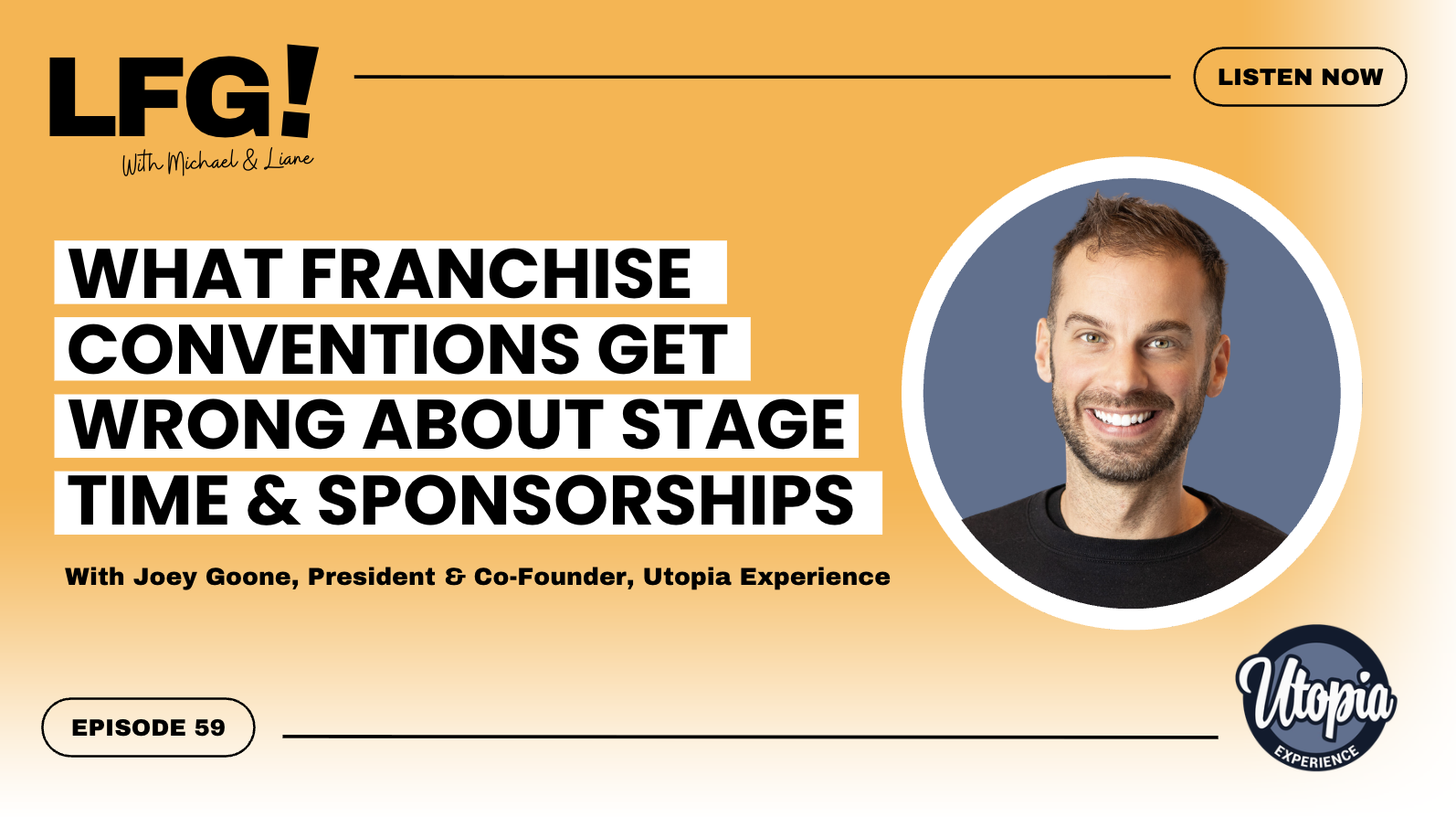
Hosts: Michael Hyam and Liane Caruso
Guests: Joey Goone, President and Co-Founder of Utopia Experience
In a recent episode of The LFG Podcast with Mike & Liane, we sat down with Joey Goone, president and co-founder of Utopia Experience, a full-service event agency with 24 years in the business and the last two years deep in the franchise space.
Joey’s mom founded Utopia Experience in their family childhood home. She planned two family events with two different event planning companies, felt like a transaction both times, and decided to do it differently. She built the company for 15 years before passing away at 51.
Joey was in wealth management at the time, not planning to take over, but after a conversation with his dad at the same kitchen table where the company was born, he stepped in and took the reins in 2014. The business has reinvented itself more than once since then, most significantly during COVID, and the pivot into franchising has been, in Joey’s words, a happy accident that turned into a focus.
Here is what he shared.
Podcast Summary: Utopia Experience President Shares How Franchise Brands Can Build Conventions That Actually Move The Needle
WHAT KIND OF EVENT COMPANY ARE YOU ACTUALLY HIRING?
Joey opened by drawing a distinction most franchise brands have never thought to make, because they assume all event planners are roughly the same.
They are not.
A DMC, or destination management company, is a local expert in a specific city. They are good for transportation, off-site experiences, dinners, decor, and navigating a local market. They are a partner, not a full-service provider.
A traditional meeting planning company handles things like hotel procurement, room blocks, and food and beverage. Some also cover schedule, logistics, and registration.
AV and production companies handle the technical production side of the event.
And then there is what Joey calls a full-service agency, which is where Utopia sits. The full-service agency looks at the event as one ecosystem. AV in-house. Attendee experience, agenda, content, and sponsorship strategy are all considered together alongside hotel negotiations, vendor relationships, registration, and logistics.
When a brand says they already have an event planner, Joey’s first question is always: what does that actually mean? Because what pieces they truly own matters enormously for what gaps exist.
The distinction he draws between a good event planner and an exceptional one comes down to the questions they ask. A good planner asks what the stage should look like, or which hotel you want. An exceptional one asks what you want franchisees thinking, feeling, or doing differently when they go home. What business outcomes do you want to create?
WHO IS ACTUALLY PLANNING YOUR CONVENTION RIGHT NOW?
Most franchise brands that call Utopia already have someone planning their convention. That person is rarely a professional event planner.
It is usually a marketer or an operations leader who was standing next to the CEO when the idea came up. And now planning the annual convention is their second full-time job.
A franchisor on Utopia’s advisory board told Joey that when he was running his brand before it was acquired, his six-person leadership team was spending four hours a week in meetings just talking about the convention. That was only the meetings.
The execution of everything those meetings produced was on top of it. His estimate: 400 to 500 hours of executive time going into the convention, which translates to $50,000 or more in leadership bandwidth, before accounting for the opportunity cost of what the marketing or ops person is not doing in their actual role because they are buried in event logistics.
Liane put it plainly: most brands keep it in-house to save money without recognizing how much they are losing at the same time.
The costs that do not show up on the P&L are still costs.
WHEN SHOULD A FRANCHISE BRAND HIRE AN EVENT AGENCY?
Joey thought about this before the conversation and landed on two signals rather than a unit count threshold, though he notes that most brands working with Utopia have north of 150 units.
The first signal is event complexity. As the convention grows in size, scope, and what it needs to accomplish, the demands on whoever is running it grow with it.
The second is opportunity cost. When the person planning the event is a marketer who should be doing marketing, or an ops leader who should be improving operations, the question is not whether the convention gets done. It is what does not get done because they are doing this instead.
Rapidly scaling systems have both of these signals, and they compound each other.
WHAT FRANCHISE CONVENTIONS SHOULD LOOK LIKE IN 2027
Michael asked what event trends franchise brands should be getting ahead of, and Joey’s answer was direct: move away from passive content and find more ways to get people participating.
If attendees are sitting through a 60-minute keynote presentation, he pointed out, they could have watched a speaker from their couch. The reason they got on an airplane is the people. The convention’s job is to build community, and passive content does not do that.
He ran through several formats worth experimenting with.
Pick-a-side debates put two franchisees on stage who have taken different approaches to the same business problem, one who insources local marketing versus one who outsources it, for example. They make their case, challenge each other, and the audience votes on which approach they believe in. The result is education that feels like a live event.
Shark Tank pitches let franchisees pitch an idea they believe could improve the system, with executives or fellow franchisees in the judges’ seats. The brand funds a small pilot for the winning idea or two, brings that owner back the following year to report on what happened, and can distribute video updates to the system throughout the year as check-ins. The convention is not just talking about innovation. It is creating it.
Kaleidoscope connections replace one speaker for an hour with four to six experts stationed around the room. Small groups rotate every 15 minutes, moving through conversations on AI, profitability, leadership, local marketing, and whatever else the system needs. The result is a faster, more intimate experience where attendees get multiple sessions in one format.
Game show sessions take content that would normally be delivered in a breakout and turn it into Jeopardy!, Family Feud, or Who Wants to Be a Millionaire? Pull questions from a pre-event franchisee survey, brand history, operational best practices, or inside jokes from the system. Competition and energy get built in while education still gets delivered.
SPONSORSHIPS ARE GETTING TOO TRANSACTIONAL
Liane asked about sponsorship strategy, and Joey did not hold back.
The standard model, where gold gets a certain logo size, and platinum gets a bigger one and someone gets their name on a cocktail napkin, is not working anymore. Sponsors want access. They want qualified conversations. They want leads.
The first conversation with any sponsor should be a phone call asking what success looks like for them. Build the package around that outcome, not around logo placement.
Joey gave a few formats that change what sponsorship feels like. Selling the arrival experience gives a sponsor one of the first touchpoints attendees encounter, like a branded hotel keycard or a room drop waiting for franchisees when they check in, an engraved whiskey glass with a handwritten welcome card, something that creates a moment rather than a mention.
Sponsoring an unforgettable experience attaches a brand to something worth remembering. When a group went to a racetrack and drove Porsches and Ferraris, the sponsor who stood up before they hit the track and said, “This experience is made possible by our company,” became part of the memory of that day.
Gamifying the expo hall gives attendees a reason to actually engage with every sponsor rather than drifting through. Badge scanning, QR codes, raffle tickets earned by visiting booths, play money redeemable for a prize-the mechanics vary, but the goal is the same: make engagement worth something.
And on the relationship side, Joey made a simple point that gets overlooked. If a sponsor is writing a check for $10,000 or more, having someone on-site check in with them throughout the event, ask whether they are getting value, find out who they have not met yet, and make an introduction, costs nothing and builds significant goodwill. Most brands do not do it.
WHAT TO ASK IN YOUR POST-EVENT SURVEY
Michael asked what a post-event survey should actually cover, and Joey pushed back on the whole framing.
Do not ask about the food. You cannot please everyone on that anyway, and the feedback will not help you build a better convention.
Ask what people are going to implement in the next 90 days. Ask who they met that changed their perspective. Ask whether they feel more confident in the brand. Ask what you should never do again.
But more importantly, do not treat feedback as only a post-event exercise. Start before the convention by calling franchisees and asking what would make the trip worth it for them, what content would get them to bring a manager or their spouse, and what city would work for their family. Let them help shape the event they are going to attend.
During the event, pulse check while it is fresh. Ask what is landing and what is missing while attendees are still in the experience.
Capture video testimonials in the room, especially after the awards ceremony or a great keynote. The best marketing for next year’s convention is happening right now at this year’s convention.
And one more: have franchisees write a letter to their future selves about what they want to accomplish in the next 12 months. Mail it back to them four to six months later as an unexpected touchpoint that connects the convention to their goals long after the event ends.
The fundamental question is whether the convention changed anything for the system. That is the bar.
WHAT TO DO WHEN THE CEO HANDS YOU THE CONVENTION
Liane asked what someone should do the moment they get handed the annual convention without asking for it.
Joey’s first answer was to say no. His second answer was more practical.
If you are inheriting an existing convention, start by understanding what you have. Pull the hotel contract from last year, the AV contract, the speaker contracts, the registration platform. Know your room block deadlines and deposit dates. Know what you are working with before you start changing anything.
Then call your franchisees and ask the questions. What would make you 100% want to come?
Then build your budget starting from hotel and venue costs rather than from an arbitrary number, because building backward from a guess just gets you a more confident guess.
Factor in whether franchisees are paying for their tickets, and whether managers and spouses are invited. Joey strongly encourages both. Spouses in particular, because the work of running a franchise goes home, and when spouses are connecting, the community gets stickier, and the system holds together better.
Charge for the convention. Most franchise brands charge between $250 and $1,500. If you are not charging, the question is why. Things people pay for feel valuable because they are valuable. Free things rarely do.
And practically, if franchisees have no money in the game, there is nothing stopping them from canceling 48 hours out and leaving you on the hook for their hotel room and food.
Then launch the registration platform, get the save-the-date out, and start designing for the attendee experience.
And call Utopia Experience as soon as the CEO tells you that you are planning the convention!
THIS EPISODE IS BROUGHT TO YOU BY…
Franchise Ninja, Adduro, Utopia Experience, Franchise Assembly, and The National Franchise Show.
Listen to the full episode now to hear more from Joey, and subscribe to the LFG Podcast so you never miss an episode!
Apple: https://podcasts.apple.com/us/podcast/the-lfg-podcast/id1818820595
Spotify: https://open.spotify.com/episode/0S2SYbin9nvtPhvufeBWml?si=qwzaOijSTlCBb070NJ-OLQ
YouTube: https://youtu.be/Me99rXuqZyY
For more on Utopia Experience, visit utopiaexperience.com or connect with Joey Goone on LinkedIn.

KEEP LEARNING FROM FRANCHISE ASSEMBLY

