

E54: Get Franchisees Found In The Age of AI Overviews: With Logical Position
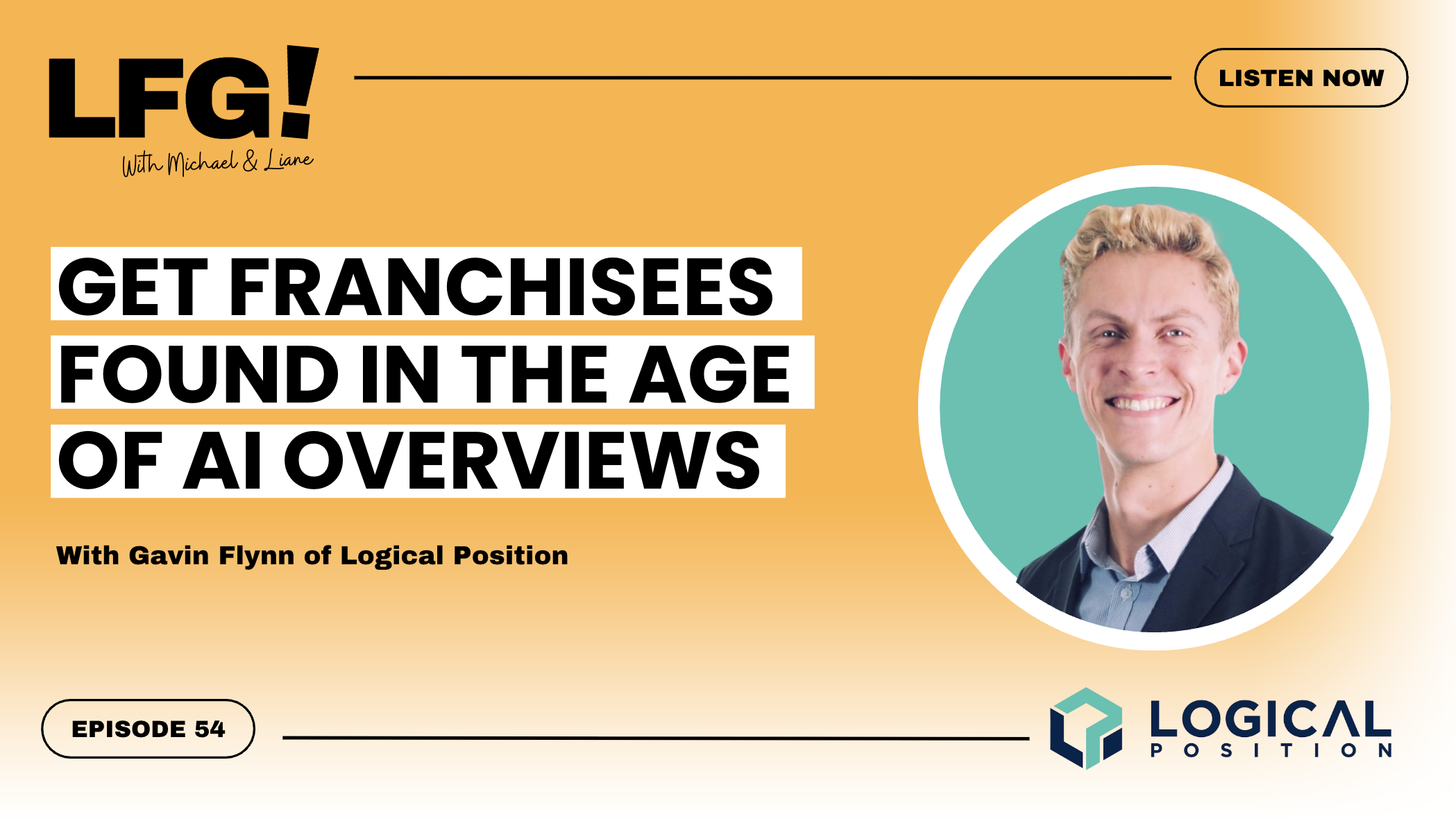
Hosts: Michael Hyam and Liane Caruso
Guest: Gavin Flynn, Acquisition Manager at Logical Position
We sat down with Gavin Flynn, Acquisition Manager at Logical Position, on the LFG Podcast this week! Logical Position is a digital marketing agency specializing in pay-per-click on Google and Meta, as well as SEO, AEO, and GEO work for AI overviews and LLM discoverability.
Gavin has been at Logical Position for close to 10 years and moved into the franchise and partner space around 2020. He spends his time working closely with franchise brands, coordinating between corporate teams and local owners, and staying on top of how fast the paid ad and search landscape is changing. He also hosts Logical Position’s own podcast, AdLab.
This was a fast-moving, technical conversation, and Gavin brought it back to earth with concrete, actionable guidance for franchise brands navigating a search environment that looks genuinely different from even 18 months ago.
PODCAST SUMMARY: GAVIN FROM LOGICAL POSITION GIVES US THE 101 ON AI SEARCH AND GETTING FOUND AS A FRANCHISE
THE SEARCH LANDSCAPE HAS ALREADY CHANGED
Gavin opened with a point worth sitting with: most of us are already engaging with AI overviews, whether we realize it or not.
Estimates of how many searches now trigger an AI overview vary widely, somewhere between 30 and 60 percent depending on the source, but the direction is clear, and it is not reversing. Users are either going directly to an LLM like ChatGPT or Gemini to start their research, or they are going to Google as they always have, and finding an AI overview at or near the top of the results page before they ever see a traditional organic listing or paid ad.
The downstream effect is what Gavin calls the no-click conversion problem. Users are doing their research within the LLM, forming a view of which brands are worth contacting, and then going directly to those brands without ever clicking through a website in a way that gets tracked. Traffic is down across the board. Conversions are not falling at the same rate. That gap is the AI research phase, and it is invisible in most analytics setups.
THE TWO THINGS FRANCHISE BRANDS SHOULD FOCUS ON RIGHT NOW
Gavin had two immediate priorities he keeps coming back to with any franchise brand he talks to.
The first is consistency of information across corporate and location entities. LLMs are scanning business hours, addresses, business names, and service descriptions across every source they can find. If the corporate website says one thing and the location page says something different, that inconsistency creates confusion for the model and weakens a brand’s chances of being surfaced accurately. Getting that information unified and clean across every entity is more important now than it has ever been.
The second is social proof and review velocity. Around 70 to 80 percent of what LLMs pull when forming their summaries comes from third-party sources: Google reviews, Yelp, Reddit threads, and other places where consumers are talking about a brand without the brand’s involvement. The volume, recency, and quality of those reviews is now a direct input into how often and how favorably a brand gets mentioned in AI-generated results.
Gavin was clear that this is not a new idea in theory, but the stakes have risen. A negative review from years ago is hard to remove, but the best counter is consistent, high-velocity positive review collection. If you do not feel good about your review capture and publication strategy right now, this is the moment to treat that as a genuine priority, not a background task.
HOW SEARCH QUERIES THEMSELVES HAVE CHANGED
The way people type into Google has shifted, and it matters for how paid campaigns are structured.
A few years ago, most users searched like keyword hunters: short, choppy, non-conversational strings that got results but did not read like sentences. Today, searches are longer, more conversational, and increasingly triggered by voice. Someone talking to their phone says a full sentence. Someone typing into an LLM writes a paragraph-length question. The queries that arrive at search platforms now are fundamentally different from what campaign structures were originally built to capture.
Gavin’s recommendation: do not throw out the existing PPC playbook entirely, but adapt it. That means leveraging AIMax within search campaigns to capture those long-tail conversational terms, moving toward broader match types with tighter negative keyword sculpting to filter out irrelevant traffic, and making sure campaign segmentation clearly distinguishes research-phase queries from high-intent buying-phase queries. Those two types of traffic have very different behaviors and should not be lumped together.
On the content side, the same principle applies. FAQs on a brand’s website have always been useful for SEO, but they are now a direct training input for LLMs. The key is writing those FAQs in the language a consumer would actually use to ask the question, not the language a marketer would use to describe a service. The more a brand’s website content anticipates the conversational way a user would query an LLM, the better positioned that content is to get pulled into AI-generated results.
HOW TO AUDIT YOUR OWN AI VISIBILITY WITHOUT SPENDING ANYTHING
Gavin offered a practical, no-cost approach for any franchise brand that wants to understand where they stand right now.
Go into ChatGPT or Gemini and run searches for the services you offer in the markets you serve. See whether your brand shows up. More importantly, look at the citations. LLMs tell you where they pulled their information from. Those citation links show you exactly which pages, which reviews, and which third-party sources are being used to represent your brand, and which ones are being used to represent your competitors.
One caveat Gavin added: this is different from testing your own paid ads. If you search for your own ads on Google, you are distorting your own account statistics, and if you click them, you are charging yourself. The LLM test searches are organic, carry no paid implications, and give you genuinely useful intelligence about how your brand is being characterized without any of the downsides.
FOR FRANCHISE BRANDS SPECIFICALLY: THE COORDINATION PROBLEM
The franchisor and franchisee coordination challenge around search and paid ads has always existed, but Gavin argued it has become more consequential in the AI era.
On the organic and LLM side, location-specific content on location-specific pages is how a franchise location gets found for local queries. Those pages need to exist, they need to have genuinely localized content, and they need to be able to piggyback on the domain authority the corporate brand has built. If franchisees have the autonomy to manage their own local marketing, the conversation between corporate and location needs to land on clear agreements about what that local content looks like.
On the paid side, the risk of uncoordinated campaigns is competing against yourself. If a corporate account is running broad match terms targeting branded and research-phase queries, and a local account is running similar terms for local intent, overlap becomes much more likely as these campaigns are expanded to capture LLM-eligible traffic. The fix is clear keyword ownership: corporate handles branded and higher-funnel terms, locations handle near-me and neighborhood-specific terms, and the segmentation is agreed upon and maintained.
THE HONEST TAKE ON PAID ADS IN LLMS RIGHT NOW
Gavin was refreshingly candid about where the technology actually is for paid ads inside AI overviews.
Sponsored listings in Gemini and Google AI overviews are available now through PMAX and AIMax campaign types, and Logical Position recommends testing them if budget allows. But Gavin’s expectation-setting was clear: these tools are still early. ChatGPT’s ad platform in particular is lagging significantly behind Google in terms of targeting sophistication. Sponsored listings there often appear at the bottom of results, are broadly targeted, and are not yet close to the relevance of traditional search ads. Treat them as a test, not a performance channel.
The broader picture he painted: Google will figure out how to monetize AI overviews, and sponsored listings will become more prominent over the next six to twelve months. Being in the market and testing now means being ready when the targeting gets better.
WHAT TO DO WITH A LIMITED BUDGET
Michael asked the practical question: if a franchise brand has limited budget, where should it go?
Gavin’s answer was grounded: traditional pay-per-click with AIMax and PMAX features implemented is still the highest-confidence starting point. PPC still shows at the top of results for many queries, millions of dollars in transactions still flow through it every week, and a meaningful portion of the population actively resists LLMs. Do not abandon the channel that is still working while the new one is still being built.
His suggested mix for most brands: a search budget alongside a social budget, roughly 70/30 or 80/20 depending on the brand. Layer in content and SEO work, which has become easier to produce and requires less budget if handled in-house with AI tools. And then, increasingly, treat review management as a genuine line item rather than an afterthought.
HOW TO THINK ABOUT METRICS THAT NO LONGER LOOK RIGHT
One of the most useful parts of the conversation was Gavin addressing what happens when the numbers stop making sense.
Year-over-year site traffic comparisons are going to look alarming for most brands right now. That is not necessarily an emergency. People are doing more of their research in LLMs and arriving at a decision before they ever touch a brand website. The traffic decline and the business result do not always move together the way they used to.
Gavin’s recommendation is to use tools like SEMrush to look at AI overview indexing alongside traditional organic ranking, so there is a clearer picture of how often and for which terms a brand is being surfaced in the research phase, not just on the traditional results page. GA4 and third-party attribution tools can also help reconstruct the full user journey, including the steps that happen before someone finally clicks.
The reframe that stuck from this part of the conversation: PPC is becoming more of a top-of-funnel and very bottom-of-funnel tool, with the AI research phase filling in the middle. The channel still has a role. That role is just different than it was two years ago, and measuring it the same way produces misleading conclusions.
WHERE TO START: REVIEWS
If there is one place to start, Gavin kept coming back to the same answer: reviews.
It is not the flashiest move, and it is not a new idea. But the weight that review volume, recency, and quality now carry in determining how a brand is represented in AI-generated results is higher than it has ever been. If a brand is not actively and consistently collecting reviews at the location level, that gap is showing up in LLM results whether the brand knows it or not.
Everything else – the campaign restructuring, the AI Max testing, the FAQ rewrites, the coordination between corporate and franchisee accounts – is worth doing. But if there is one thing to put energy into this week, make it the review strategy.
THIS EPISODE IS BROUGHT TO YOU BY…
NetSertive, Franchise Ninja, Franchise Assembly, and The National Franchise Show.
Listen to the full episode now to hear more from Gavin, and subscribe to the LFG Podcast so you never miss an episode!
Listen on Apple, Spotify, or YouTube.
For more on Logical Position, visit logicalposition.com. There is a franchise-specific page on the site, and contact forms go directly to Gavin. He is also happy to just talk shop with anyone curious about what is happening in search right now, no pitch required. You can also find his podcast, AdLab, wherever you get your podcasts.

KEEP LEARNING FROM FRANCHISE ASSEMBLY

