

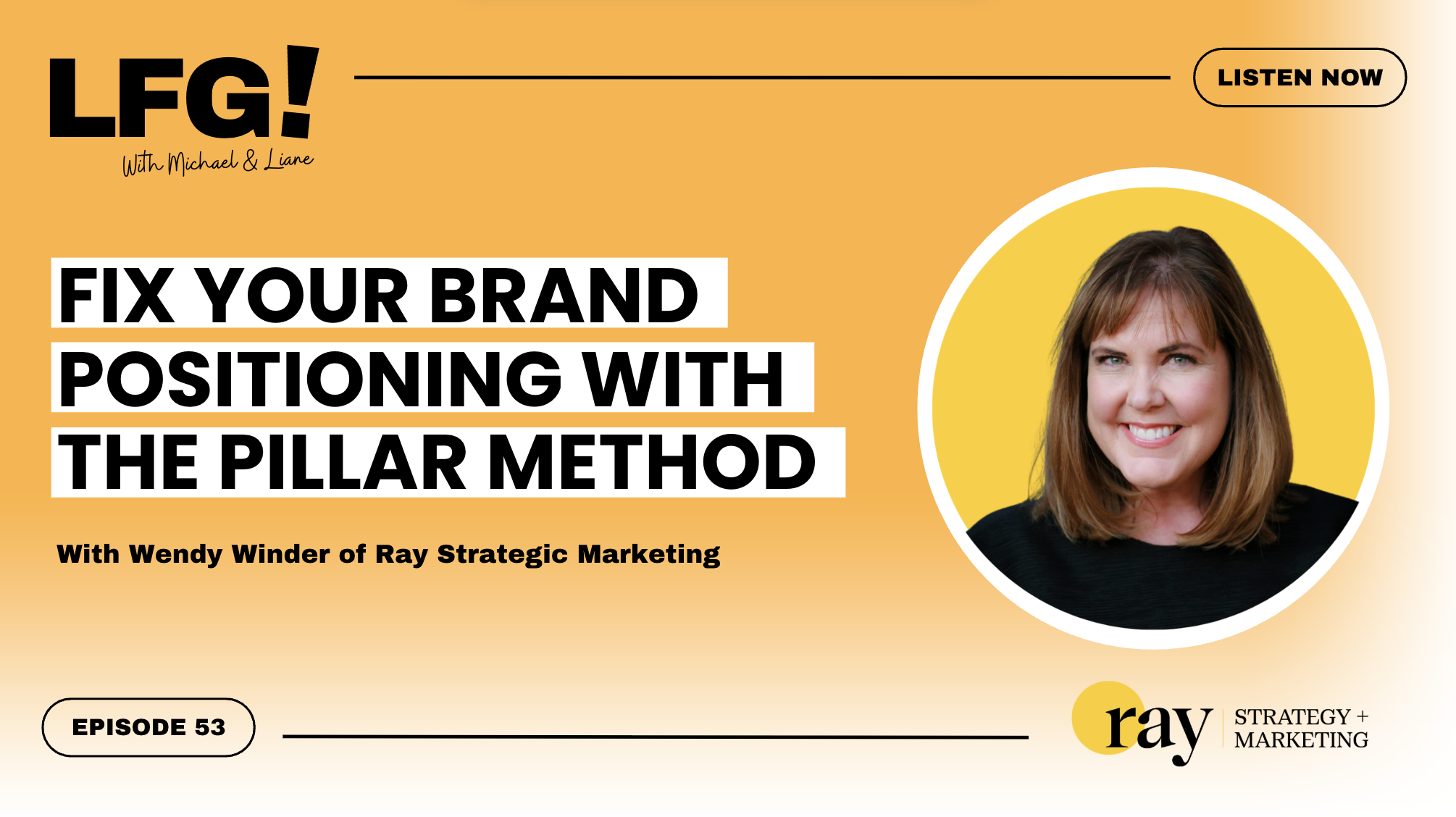
E53: Fix Your Brand Positioning With The Pillar Method: With Ray Strategic Marketing
Hosts: Michael Hyam and Liane Caruso
Guest: Wendy Winder, Founder of Ray Strategic Marketing
Wendy Winder, founder of Ray Strategic Marketing, joined the LFG Podcast to share her expertise on marketing and branding foundations. Ray Strategic Marketing is a boutique strategy and marketing firm built around one core belief: before you do anything else, you have to get the foundation right.
Wendy spent 25 years leading marketing teams inside franchise organizations before launching Ray. She is a fellow Canadian to Michael, a fellow fractional to Liane, and someone who has seen firsthand what happens when brands skip the foundational work and jump straight to tactics. Here is what she shared.
PODCAST SUMMARY: WENDY FROM RAY STRATEGIC MARKETING GIVES THE BRAND POSITIONING PILLAR BREAKDOWN
WHY RAY EXISTS: THE GAP WENDY KEPT SEEING
After 25 years on the client side, Wendy built Ray to solve two problems she kept running into throughout her career.
The first was the traditional agency model. Agencies would come in, disappear to “do the magic,” and come back with a polished presentation expecting the internal team to run with it. In her experience, those strategies rarely got adopted, because the team was never part of creating them and the agency did not really understand the nuances of the franchise system.
The second problem was a skills gap: nobody is teaching franchise marketers how to do foundational strategic work. How to do positioning. What a research-driven approach looks like. How to connect the marketing plan to a real business strategy instead of a wish list of 20 things. Wendy wanted to build something that filled both of those gaps at once.
Ray operates as fractional senior marketing leadership with a full plug-and-play marketing department behind it. Brands can use the firm to fill a capacity gap, support a junior team, or simply get a senior strategic voice in the room. And rather than trying to be the expert at every execution specialty in-house, Ray maintains a network of bench partners who are specialists in their respective areas, from media buying to AEO and GEO. Part of the expertise, as Wendy put it, is knowing the landscape and matching the right expert to the right brand at the right moment.
WHAT POSITIONING REALLY ADDRESSES
Liane asked a question worth sitting with: do brands come to Wendy knowing they need positioning, or do they usually come in asking for something different?
The honest answer: almost always something different. Usually they want someone to audit their marketing and tell them if it is working. They are starting with tactics, and they want a tactics check.
Wendy’s approach is to redirect that conversation upstream. Before you can assess whether the tactics are working, you need to know whether the brand itself is solid. An excellent marketing plan built on a shaky or unclear brand will not perform. A sales team given unclear messaging to work with will struggle regardless of how good they are.
Positioning itself is not complicated. Wendy breaks it down into four components: who the brand is for, what its unique value proposition is, where it is positioned to win in the market, and what the reasons to believe that positioning are. Once those four things are clear, the marketing strategy has something real to build on.
What makes the process meaningful is how Ray gets there. Rather than doing research in isolation and presenting conclusions, Wendy’s team conducts qualitative interviews across the full ecosystem: head office team members, franchisees, master franchisees, FAC councils, and customers. Sometimes also non-customers, depending on what the brand is trying to understand. The insights from those conversations are treated as the gold. From there, competitive analysis and market context get layered in, and then the whole team works collaboratively to figure out who the brand is really for and what makes it genuinely different.
THE THREE-PILLAR UVP METHOD
One of the most practical things Wendy shared was her framework for capturing and communicating a brand’s unique value proposition.
Most positioning exercises result in a long positioning statement: a complex sentence that attempts to capture everything about the brand in one place. The problem is that nobody can remember it. Teams come back to it six months later and it is gone from their heads.
Wendy’s preferred approach is the three or four pillar method. Instead of a statement, you identify three or four things the brand does exceptionally well. Competitors might do one or two of them. Nobody else does all of them together. That combination is the secret sauce.
The simplicity is the point. Everyone in the organization can remember three or four things. And that clarity becomes the backbone of how the brand talks about itself, how strategy gets prioritized, and how the team stays aligned when pressure builds and decisions have to get made quickly.
Wendy gave a case study from her corporate days at Jugo Juice, a juice franchise that had just been acquired by MTY. The team did the positioning work, got locked in on one of their pillars: being the healthy option for people on the go. They were not quite there yet. But with the whole team aligned on that direction, they went to work. They refreshed categories, hired a menu innovation person, and pushed to be first to market with kale in smoothies.
The first version did not hit. The second one did. Within 18 months, the brand moved from double-digit negative to double-digit positive growth, in a period when the QSR category broadly was struggling. That is what happens, in Wendy’s framing, when you have a simple, focused plan and everyone is rowing in the same direction.
POSITIONING IS NOT A MARKETING EXERCISE, IT IS A COMPANY EXERCISE
This was one of the most important distinctions Wendy made throughout the conversation, and she returned to it more than once.
Positioning is not something the marketing team goes off and does on their own and then hands down to the rest of the organization. It has to involve everyone: head office leadership, the CDO, the franchisees, the frontline. The moment those stakeholders are included in the research and the collaborative process, something shifts. They feel heard. They understand that the brand actually cares about their perspective. And when the positioning comes back to them, they recognize their own voice in it.
That buy-in has a direct downstream effect on both franchise development and local marketing. For FranDev, having deep qualitative conversations with franchisees gives you the raw material to build genuinely specific, validated personas. Not guesses about who makes a great franchisee but real, evidence-backed profiles drawn from conversations with the rock stars already in the system. For local marketing, those same relationships create a foundation for collaborative conversations about how to bring the brand to life at the location level.
YOU DO NOT NEED TO HAVE A PROBLEM TO DO THIS WORK
Wendy made a point that she wanted franchise brands to hear clearly: do not wait for something to break before doing the foundational work.
Brands often assume that positioning is something you address when growth has stalled or something is visibly wrong. Wendy has found the opposite to be true. The brands she works with that are already winning, already growing, already collecting awards, still find a ceiling they can push through when they do this work with fresh eyes and real data behind it.
She mentioned two current clients as examples. Tom Eugen’s Original Barbershop is a growing, award-winning brand. Wendy admitted she had a moment early in that engagement wondering if there was anything she could add. There always is. Getting sharper on what makes the brand uniquely itself, even from a position of strength, creates competitive advantages that accumulate over time.
Elite Trade Painting is a smaller, established brand ready to push into a new phase of growth. Painting is a low-trust category. Differentiation is genuinely hard. The positioning work is helping them find and articulate what makes them distinct in a way that will carry their next growth phase.
Wendy’s general guidance: you do not need to do this every year, but if it has been three to five years since you last did a real positioning review, it is time.
THE ONE THING FRANCHISE BRANDS SHOULD TAKE FROM THIS
The consistent thread through everything Wendy shared is deceptively simple: do not skip the foundation.
Franchise brands are under constant pressure to grow, to generate leads, to hit numbers. That pressure pulls everyone toward tactics and execution. But tactics built on unclear positioning are, at best, inefficient, and at worst, actively misleading prospective franchisees about what the brand actually is.
Getting the positioning right, and doing it through a process that involves the whole team, is what makes every downstream activity more effective: the marketing plan, the FranDev messaging, the local execution, the sales conversation. The foundation is not the slow part. It is what makes everything else faster.
THIS EPISODE IS BROUGHT TO YOU BY…
NetSertive, Franchise Ninja, Franchise Assembly, and The National Franchise Show.
Listen to the full episode now to hear more from Greg, and subscribe to the LFG Podcast so you never miss an episode!
Listen on Apple, Spotify, or YouTube.
For more on Ray Strategic Marketing, visit raystrategicmarketing.com or connect with Wendy on LinkedIn. She nerds out on this stuff and is happy to chat with anyone.

KEEP LEARNING FROM FRANCHISE ASSEMBLY

