

E51: Where The Marketing Gap Is In Franchise Sales: With Apollo CMO
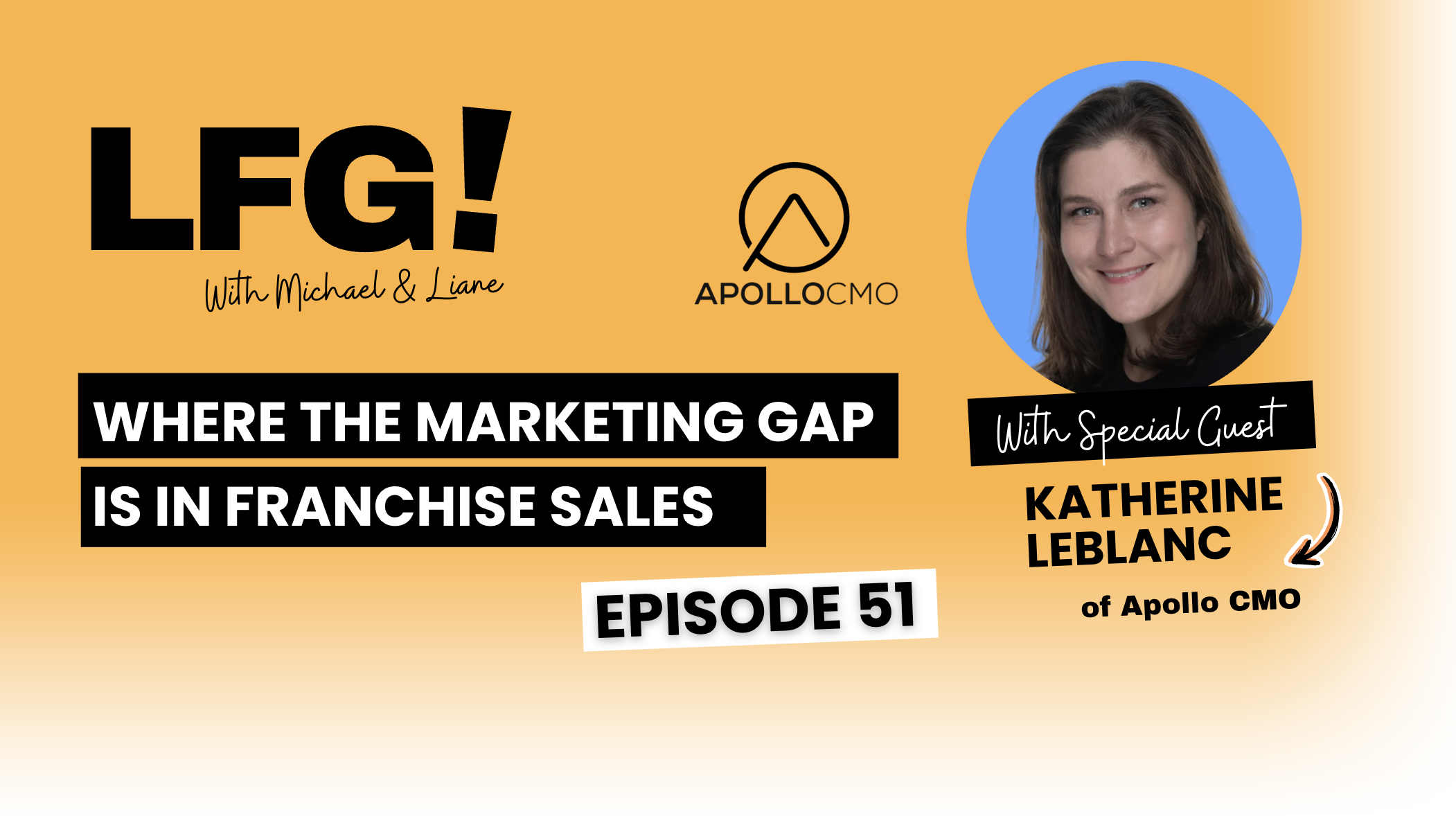
Hosts: Michael Hyam and Liane Caruso
Guest: Katherine LeBlanc, Fractional CMO & Franchise Growth Consultant at Apollo CMO
In a recent episode of The LFG Podcast with Mike & Liane, we sat down with Katherine LeBlanc, a franchise growth and marketing consultant with 13 years in the franchising industry, capping off a 20-year marketing career.
Katherine has worked across food, health and wellness, and a wide range of franchise verticals. She now operates as a fractional CMO and consultant through Apollo CMO, helping brands solve one of the stickiest problems in franchising: the structural disconnect between consumer marketing and franchise development marketing.
This was a candid, unscripted conversation between two people who work in this space every day, and it surfaced some things that not enough franchise leaders are saying out loud. Here is what they shared.
PODCAST SUMMARY: BRIDGING THE CONSUMER AND FRANCHISE DEVELOPMENT MARKETING GAP WITH APOLLO CMO
TWO BRANDS, ONE BUDGET
Katherine opened with a statement that cuts right to the heart of the issue: franchise brands are actually running two brands simultaneously.
There’s the consumer brand, focused on driving demand for franchisees so they can achieve profitability and growth.
And then there is the franchise development brand, focused on attracting the right people to invest in the system. Both brands need marketing. But in most organizations, only one of these brands has a dedicated marketer in the room.
The consumer marketing team is rightly focused on consumers. That is where the pressure is, that is where the daily accountability lives, and that is where most CMOs spend their time. Franchise development, meanwhile, gets handed off to a CDO and an agency, with a brief around more leads. And from that moment, the two brands start drifting apart.
The franchise development budget gets treated as a lead gen budget, full stop. There is no line item for a franchise development marketer within the same ecosystem. There is no person whose job it is to make sure the messaging, the creative, the website, and the strategy on the development side actually connect back to the consumer brand.
WHY THE HANDOFF GOES WRONG
On paper, the solution sounds simple. Set the brand guidelines, hand them to the CDO and the agency, and let them execute. Katherine has watched this play out enough times to know exactly where it falls apart.
The first point of failure is creative. Creative is one of the most underestimated elements in marketing, and the rise of Canva and AI has made everyone feel like a designer. But there is a meaningful difference between quality creative and generic creative, and consumers feel it even when they cannot name it.
When a brand hands off its guidelines without ongoing oversight, small things start to shift. The primary brand color gets pushed to secondary. The tone drifts. The visual language becomes slightly disconnected from what a prospect has already seen on the consumer side. And because the CDO is not a marketer, and the agency is optimizing for leads rather than brand, nobody flags it.
Katherine’s point is sharp: franchise prospects are, first and foremost, customers. They have likely interacted with the consumer brand before considering an investment in it. If the development brand feels disconnected from that experience, it introduces a subtle but real friction into the buying process.
THE DIRECT ATTRIBUTION ADDICTION
Both Katherine and Liane named the same structural driver behind this problem: an obsession with direct attribution.
Franchise development budgets tend to flow to whatever can be measured. PPC, Meta, sometimes LinkedIn. Activities that generate a lead number, a cost per lead, and a clear ROI tie. The problem is that this orientation systematically defunds brand building, which is foundational but slow, and the returns are not trackable in a dashboard.
Katherine used PR as an example.
PR is having a resurgence right now, in part because it connects to the AI visibility conversation. But it has always been a strong brand-building tool, one that builds credibility, expands reach, and signals legitimacy to prospective franchisees who are doing their own research. It gets cut from budgets not because it does not work, but because the attribution is invisible.
The result, over time, is a pipeline that relies entirely on paid demand capture while the foundation underneath it slowly weakens. Katherine described the pattern this way: you put a dollar in and get three dollars out, so you pour everything into that channel. A year later you are getting two dollars out. A year after that, a dollar. Because you never invested in the demand creation that makes the paid channel efficient.
WHAT ON-DEMAND CREATION ON THE FRANDEV SIDE LOOKS LIKE
This is the piece that Katherine says most franchise development programs leave entirely on the table. She’s seen it time again in her work with Apollo CMO.
There are two layers to any development marketing program. The first is the transactional layer: paid media, portals, outreach, the activities that generate leads and move people through the funnel. This is where most of the budget goes, and it is necessary.
The second is the foundational layer: the ongoing investment in positioning the brand as the right investment to make. Strong operations. Strong franchisee reviews and testimonials. A clear and consistent message about what makes this brand different from the 50 others a prospect might be evaluating. Content that helps prospects self-select before they ever fill out a form.
This foundational layer does not generate a lead this week. It generates the trust that makes a prospect take the call next quarter, or complete the application six months from now, or stay in the consideration window for three years and eventually sign. Without it, the transactional activities are fishing in a pond that keeps getting smaller.
Katherine made a point that stuck: most franchise development brands are all saying the same things. Low cost to open. Simple to run. Turnkey system. These headlines drive leads in the short term. They also attract people who are not the right fit, inflate the pipeline, and contribute to the attrition between lead and close that CDOs then blame on lead quality rather than message quality.
THE SHARED METRICS PROBLEM
One of the most actionable threads in the conversation was the shared metrics question.
When marketing owns the top of the funnel, and sales owns everything below it, neither side has full visibility into what is happening. Marketing sees lead volume and cost per lead. Sales sees closes. Nobody is consistently tracking what happens in between: how many leads took a discovery call, how many made it to the FDD, where in the funnel the system is losing people and why.
That information does not just sit with sales. It should be flowing back to the marketing team and to any agency running paid media, so that messaging and targeting can be refined based on what actually converts rather than what generates a click.
Katherine’s point on agencies is worth highlighting: digital media agencies get a bad reputation in the franchise space, but a lot of the time they are simply not set up for success. They are handed a brief to drive more leads and given no visibility into how those leads actually performed downstream. Without that feedback loop, the agency is optimizing for the wrong thing.
HOW APOLLO CMO DEALS WITH OWNERSHIP
Michael asked the question directly: who should be the owner here, the CMO or the CDO?
Katherine’s answer did not try to land on one or the other. In her view, the real solve is not about org charts. It is about cross-departmental partnership at the human level.
When she operates as CMO, her instinct is to reach across to the CDO and ask: what do you need, and how can I help you get to your numbers? Not to take over the relationship or override the structure, but to be an advocate and a resource. A CMO who understands the development side can help the CDO make the case internally for more marketing support, more budget, and more strategic investment in brand building.
The organizations that make this work, in her experience, are not necessarily the ones with the clearest accountability charts. They are the ones where people at the director and manager level are reaching across to each other and asking how they can help the other person succeed.
Liane added a note of caution from the other direction: she has also seen brands where marketing controlled everything on the development side and kept sales completely locked out, with no visibility into vendor calls, lead quality, or what was and was not working. That version of silos is just as damaging, only in the opposite direction.
THE SOLVE, AND WHERE IT STARTS
Katherine closed with a practical take on what brands can actually do about this.
The answer does not always require a full-time hire. A consultant or fractional CMO embedded with the development team, even in a part-time capacity, can serve as the marketing voice that is otherwise absent. Someone who can do a periodic check-in, assess whether the messaging is holding together, make sure the creative is consistent, and raise the flag when something is drifting.
She also made the case that strategic agencies have a role to play here, if they are willing to step into it. Rather than just running ads, agencies working in the franchise development space can add genuine value by helping clients think through the full funnel, not just the top of it.
The consistent through-line in everything Katherine said was this: there just needs to be a marketing voice at the table in the franchise development conversation. Not necessarily a full department. Not necessarily a massive budget shift. Just someone who understands how brand building works, what the prospect journey actually looks like, and how to close the gap between where the brand is and where it needs to be.
THIS EPISODE IS BROUGHT TO YOU BY…
NetSertive, Papirfly, Franchise Assembly, and The National Franchise Show.
Listen to the full episode now to hear more from Katherine at Apollo CMO, and subscribe to the LFG Podcast so you never miss an episode!
Listen on Apple, Spotify, or YouTube.
For more on Apollo CMO, visit apollocmo.com. You can also find Katherine’s podcast, Dear Franny, wherever you get your podcasts, and her interview series, Franchise Spotlight with Katherine LeBlanc, is available for franchise leaders looking to go deeper on topics like this one.

KEEP LEARNING FROM FRANCHISE ASSEMBLY

