

E58: What a Real Streaming TV Budget Should Look Like for Franchises: With Adduro
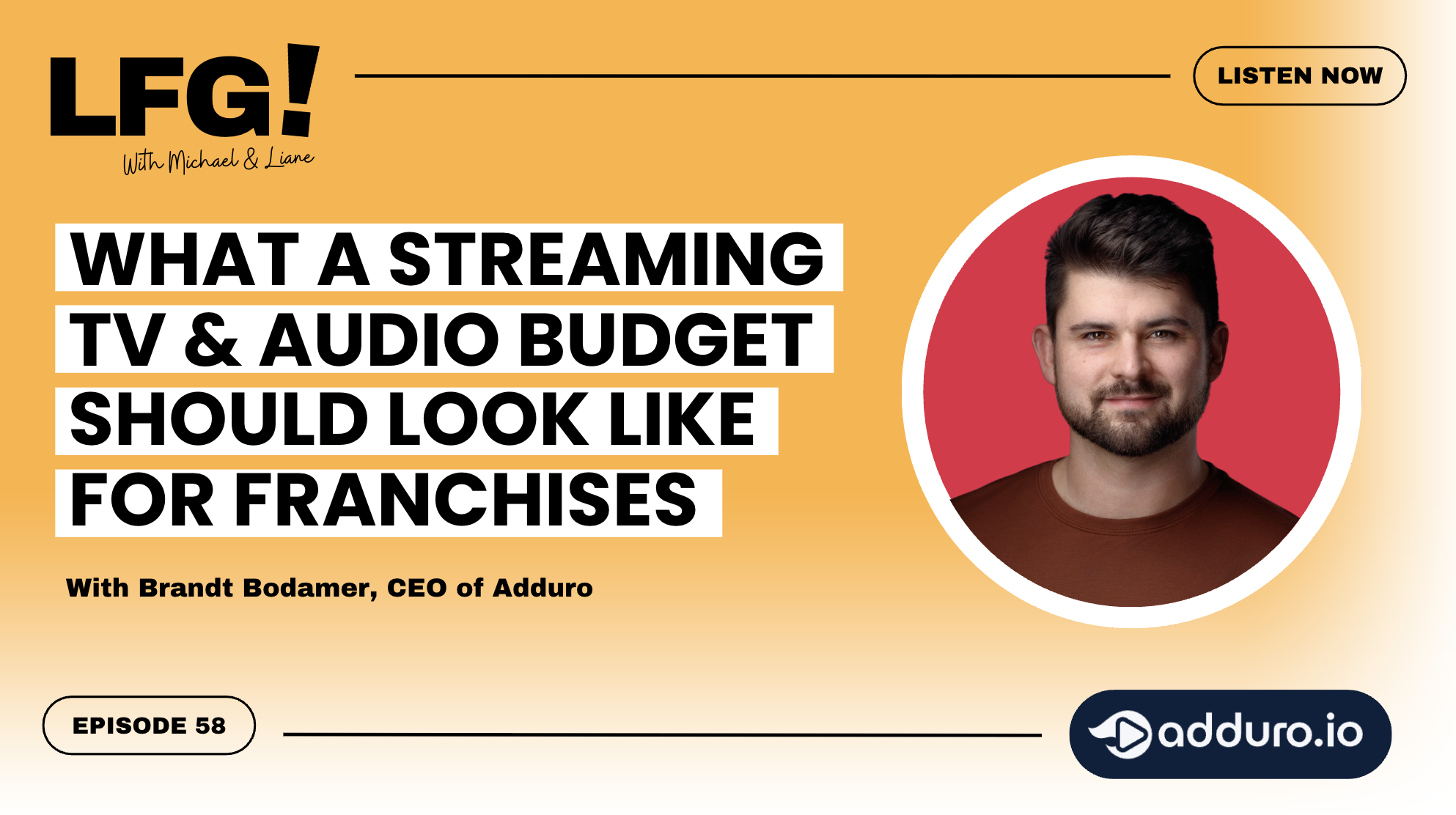
Hosts: Michael Hyam and Liane Caruso
Guest: Brandt Bodamer, Founder and CEO of Adduro
In a recent episode of The LFG Podcast with Mike & Liane, we sat down with Brandt Bodamer, founder and CEO of Adduro, a streaming TV and audio advertising platform built specifically to do what most vendors in the space will not: use real data to tell you exactly what to spend before you spend it.
Brandt grew up on a small island in Washington state with one stoplight, made his way to Denver, and built a career that started in home services and contracting before moving into digital marketing. He started Adduro because he kept buying streaming ads and kept getting frustrated with vendors who couldn’t explain their recommendations. Here is what he shared.
PODCAST SUMMARY: STREAMING TV, AUDIO, AND SMARTER FRANCHISE ADVERTISING WITH ADDURO
BRAND AWARENESS VS LOCATION PERFORMANCE
Liane opened with something she sees constantly as a fractional CMO: franchise brands treating brand awareness and local performance marketing as an either-or decision, when they are not.
Brandt agreed and traced the misunderstanding to vendors who prefer simple conversations. It is easier to tell a client it is one or the other than to work through the actual nuance. But the nuance matters.
His core point: awareness starts the performance. In a city, there is no shortage of QSRs or retail options within a five-mile radius of wherever a customer is standing. If they do not know your location exists, no performance campaign in the world will reach them. You cannot click on an ad for a restaurant you have never heard of. Awareness is what makes the bottom-of-funnel dollars worth spending.
He used the example of Chipotle: no one is surprised to hear Chipotle exists, but they might be surprised to learn there is one closer to them than they thought. The job of local brand awareness is not to announce the category; it is to make the specific location known. That is where streaming TV and audio live.
FIRST-PARTY DATA AND WHO SHOULD CONTROL IT
Michael asked about first-party data in the franchise context, including who owns it and what brands should be doing with it.
Brandt’s answer came with a practical warning: the aggregated data from the franchisor is not enough on its own, and franchisees need to push for access to their individualized data as well.
Here is why. If the franchise system as a whole performs well with a certain demographic nationally, that does not mean every location performs well with that demographic. State to state, county to county, the demographic makeup changes. The competition changes. The size of the market changes. A location that is underperforming with a group the system does well with nationally now has a clear target for its top-of-funnel investment.
Top-of-funnel does not mean reaching everyone in a market. It means reaching the right people in the right places. Knowing where your individual location has historically had success is what makes that targeting precise rather than expensive.
Brandt’s recommendation to any franchisee: regardless of what the franchise agreement says about data ownership, make sure you have contractual access to your own location-level data, not just the system-wide aggregate. The differences between those two datasets are often where the most valuable insights are hiding.
WHAT FRANCHISE MARKETERS GET WRONG ABOUT STREAMING ADVERTISING
Michael asked what most franchise marketers misunderstand about streaming TV and audio advertising, and Brandt pointed to something the industry has quietly let slide for years: conflating website visits with revenue.
The Standard Metric
IP-based conversion tracking is the standard metric most streaming vendors lead with. Someone sees your ad on their connected TV, visits your website, and that visit gets attributed to the campaign. Vendors present this as performance. Brandt’s view is that it is a feel-good metric, and a misleading one.
Website Visits Are Not Revenue
Website visits do not equal revenue. People accidentally click on things constantly. A display or YouTube campaign will never show zero conversions because accidental visits happen at scale. If your marketer is being held to a standard, and that standard is website visits, you are optimizing for the wrong thing.
Inbound Call Tracking
For franchise categories where most leads come in by phone, Adduro integrates directly with call tracking systems. Each inbound call gets matched to the specific ad that was served to that household before the call came in. When that data is connected to a CRM properly, you can trace real dollars to specific advertising impressions. That is one step beyond website visits, and it is the direction every measurement conversation should be moving.
Brandt’s general rule: no matter how sophisticated your attribution setup is, you always need the fallback check. Did the numbers go up? If the tracking says it worked but sales are flat, something is wrong. If the tracking is imperfect but sales are moving, something is working.
METRICS BY BUSINESS MATURITY
Liane pushed on a real tension every franchise marketer faces: the C-suite wants leads, but streaming and audio are top-of-funnel channels that do not hand you a lead count on a silver platter. How do you report in a way that keeps everyone honest?
For New Locations
For a brand new location still trying to build any momentum at all, the early question is simply: are we spending money and is activity happening? That is the whole test. You cannot run a controlled A-B experiment when you are still trying to get people through the door for the first time.
For Established Locations
For a more established location with a working model, you can start changing individual levers and measuring the results. One lever at a time. That is when more precise attribution becomes possible and meaningful.
For QSR Brands
For QSR brands specifically, one of the cleanest methods is loyalty program matchback. When a customer signs up for a loyalty program with their email, you can ingest that email and match it against streaming login data to determine whether your campaign served that household an ad before they signed up. That connects an advertising impression to a real customer acquisition in a way that is harder to argue with.
HOW BUDGETS ACTUALLY WORK IN STREAMING ADVERTISING
The question of whether brand awareness spending should come from the brand fund or from individual location budgets does not have a single right answer. Brandt has seen it structured both ways.
Some franchise systems handle all top-of-funnel awareness at the corporate level. Others provide rebates to locations that can document brand-level spending, similar to the co-op advertising model common in automotive. In those cases, Adduro works directly with individual franchisees to build a strategy for their specific market.
And geography matters more than most campaigns give it credit for. Brandt sees too many streaming campaigns targeting a full DMA or an entire state when the right answer is to target the three zip codes around the location.
No one drives 45 minutes for frozen yogurt. A dense urban market needs a tight geo. A more spread-out market where people drive longer distances for services can support a wider radius. Matching the geo to the actual customer behavior is where the efficiency is.
WHAT A CREDIBLE PILOT ACTUALLY LOOKS LIKE
Michael asked what a smart test looks like for an emerging brand that does not have a large advertising budget but wants to know if streaming TV and audio can work for them.
Brandt’s answer started with a story about why he built Adduro in the first place. Every vendor he talked to before starting the company gave him the same non-answer: start with $5,000 a month and target the whole DMA, let’s see how it goes. He could never get a real explanation for why that number, or why that geography.
Adduro’s approach is different. The platform builds a comprehensive model from census data, looking at every zip code, the demographics, the income levels, and then pairs that with live streaming data to determine how many households in a given market fit the target profile.
From there, it models how many times those households need to be reached to actually drive awareness, because frequency matters. Hitting a household once a month versus twice a month is twice the budget, and that choice needs to be intentional.
The result is a specific, defensible recommendation rather than a guess. In a smaller market like Cedar Falls, Iowa, a campaign can work starting around $2,000 to $2,500 a month. A franchise group covering all of California might spend millions a month to reach tens of millions of people. The right number depends on the size of the addressable market, the desired reach, and the frequency needed to move the needle.
TREAT TV AND AUDIO AS A PART OF PERFORMANCE MARKETING
The thread running through everything Brandt shared is that streaming TV and audio advertising works best when it is treated as a strategic complement to performance marketing, not a replacement for it, and not an afterthought.
Awareness creates the condition for performance. First-party data, used at the location level rather than only the system level, tells you who to reach. The right geo, built around actual customer behavior rather than administrative boundaries, tells you where. And measurement that goes beyond website visits to actual call tracking and revenue tells you whether it is working.
For franchise brands that have been skeptical of streaming and audio because the attribution felt murky or the vendors felt hand-wavy, Adduro argues that the murkiness was a vendor problem, not a channel problem.
THIS EPISODE IS BROUGHT TO YOU BY…
Franchise Ninja, Adduro, Utopia Experience, Franchise Assembly, and The National Franchise Show.
Listen to the full episode now to hear more from Brandt, and subscribe to the LFG Podcast so you never miss an episode!
Listen on Apple, Spotify, or YouTube.
For more on Adduro, visit adduro.io or connect with Brandt on LinkedIn.

KEEP LEARNING FROM FRANCHISE ASSEMBLY

