

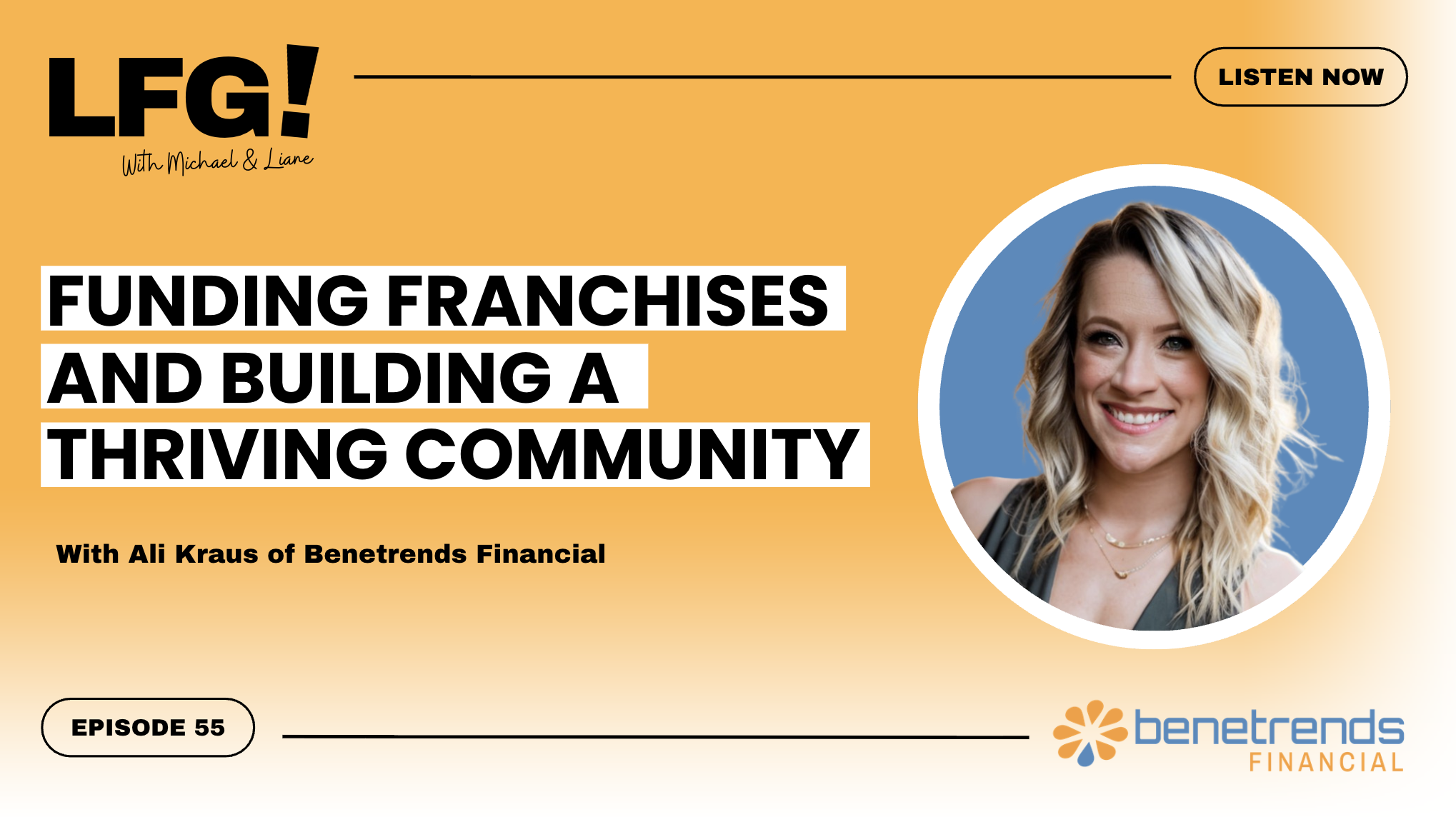
E55: Funding Franchises and Building Community: With Benetrends Financial
Hosts: Michael Hyam and Liane Caruso
Guest: Ali Kraus, CFE, Chief Marketing Officer at Benetrends Financial and Chair of the IFA Women’s Franchise Committee.
In a recent episode of The LFG Podcast with Mike & Liane, we sat down with Ali Kraus, CMO at Benetrends Financial and one of the most genuinely connected people in the franchise industry.
Ali has been at Benetrends for over four years, leading marketing for a company that has been in the franchise funding space for 45 years. She is also the current Chair of the International Franchise Association’s Women’s Franchise Committee, a role she stepped into in February 2026 after seven years on the committee.
Her relationship with the show’s hosts predates the podcast by years, and the conversation had the warmth and candor of people who have known each other through the full arc of careers in franchising.
PODCAST SUMMARY: FRANCHISE FUNDING, COMMUNITY, AND THE LONG GAME OF RELATIONSHIP BUILDING WITH BENETRENDS
WHAT BENETRENDS ACTUALLY DOES, AND WHY IT IS ITS OWN CATEGORY
Ali made a point early in the conversation that reframes how most people think about a funding company’s role in franchising.
You cannot open a business without funding. Even entrepreneurs who self-fund need someone to educate them on their options before they make that decision. That is why Ali describes Benetrends less as a supplier and more as its own standalone category in the industry. It is not a nice-to-have vendor relationship. It is a foundational part of how franchise systems grow.
Benetrends works with entrepreneurs, consultants, brokers, advisors, and franchisors across the industry to help candidates understand that funding is not one-size-fits-all. The company has been around for 45 years; its founder, Len Fisher, remains chairman of the board, and in 2026 he was named IFA Entrepreneur of the Year, a notable recognition for someone on the supplier side of the business.
Beyond the headline services, Benetrends writes three-year financial projections and business plans as part of its work, and works with more than 60 lenders across the SBA space. That depth of lender knowledge means they know exactly what banks want to see in a business plan, which informs how they advise candidates long before a loan application is filed.
THE TWO MOST COMMON FUNDING PATHS FOR FRANCHISE BUYERS
The two funding tools Ali referenced most in the conversation are Rollovers for Business Startups (ROBS) and SBA loans, and often a combination of both.
ROBS allow entrepreneurs to use retirement funds to invest in a business without triggering early withdrawal penalties or tax consequences. Benetrends was foundational in establishing the ROBS structure with the IRS 45 years ago, and because that structure is so heavily regulated by the IRS and pension plan oversight, it has stayed relatively stable compared to other funding vehicles.
SBA lending, by contrast, moves constantly. Summer 2026 saw a notable disruption: approximately 4,800 brands were dropped from the SBA directory, which created significant urgency for franchise brands and their development teams trying to understand how to keep candidates moving through the pipeline. Ali’s point about this kind of volatility is practical: the value of having a funding partner with a direct phone relationship, not just a website, is that when these changes happen, franchisors and FranDev teams have someone they can call immediately to understand what it means for their candidates.
One combination worth knowing: it is possible to use ROBS as the cash injection for an SBA loan, meaning the two strategies can work together. Many entrepreneurs do not know this is an option.
On working capital specifically, Ali noted that it is consistently underestimated, particularly as described in FDDs. Benetrends tends toward the high end of working capital recommendations precisely because having adequate runway at the start of a business materially affects the likelihood of long-term success.
ON FUNDING AS MORE THAN A FINISH LINE
The framing Ali kept returning to was this: getting funded is not the end of the journey; it is a critical part of the beginning.
People tend to fall in love with a franchise brand or a business concept first, and think about the money later. That is understandable, but understanding your capital needs early, including how much you need, what your options are, and what your working capital requirements actually look like, can completely change which brand makes sense for a given individual.
The most useful role a funding partner plays, in Ali’s view, is in that early educational phase before a decision is locked in. The question is not just can you fund this, but what structure fits your situation, and what are the implications of each path over the first three years of the business.
HOW TO ACTUALLY BUILD A NETWORK IN FRANCHISING
This was the part of the conversation Ali could, by her own admission, talk about for hours.
Franchising is a relationship-driven industry, and Ali’s presence in it is not accidental. It is the product of years of consistent, intentional showing up: going to conferences, joining committees, volunteering, sitting next to someone unfamiliar and introducing yourself, saying yes to things before you feel fully ready.
LONG-TERM INVESTMENT INTO RELATIONSHIPS
Her core point for anyone new to the industry, particularly new suppliers, was blunt: you cannot attend one event, put your name on a room card, and expect a network to materialize. The brands worth winning as clients, whether it is a Tropical Smoothie or a Dunkin’ at scale, are not going to appear after one introduction. Building the kind of network that generates those relationships takes years, and the investment has to come before you know whether it will pay off.
The phrase she has found herself using more and more this year: your network in franchising is not something you build when you need it. You build it long before you need it.
ALI’S EXPERIENCE IN THE FRANCHISE COMMUNITY
Ali’s experience of community in this industry has also made her better at the actual work. Being in rooms where franchisors, franchisees, consultants, and suppliers are talking openly about what they are struggling with gives her insight into the industry that no marketing brief or strategy deck can replicate. She knows what problems people are actually trying to solve because she is in those conversations, not just marketing at the people having them.
WHAT TO DO TO START BUILDING COMMUNITY
Her practical advice for anyone looking to break in: give before you ask. Make introductions for other people. Promote someone else’s work before your own. Volunteer for things where you will not have the spotlight. Show up to the emerging events and the smaller regional gatherings, not just the flagship shows. And expect it to take longer than feels comfortable, because franchising rewards consistency and patience in a way that the always-on, instant-results mindset of most modern marketing environments does not prepare people for.
Liane added a related perspective from her own experience: a CEO she met at her first emerging conference was too early-stage to work with at the time. She stayed loosely in touch over three years. When the brand was ready, she was the first person he called. The relationship had no clear return on investment for most of its existence. That is how the best ones in this industry tend to work.
THE IFA WOMEN’S FRANCHISE COMMITTEE
Ali has been on the IFA Women’s Franchise Committee for nearly seven years, and stepped into the chair role in February 2026. She is openly emotional about what the committee means to her, and she spoke about it with the kind of energy that comes from genuine commitment rather than obligation.
THE COMMITTEE’S MISSION
The committee’s mission is to connect, learn, lead, and amplify the voices of women across the franchise industry. In practice, that spans several different touchpoints worth knowing about.
Women’s Franchise Network chapters are one of the most accessible entry points. There are now 28 chapters across the country, and they are open to both men and women. Most host virtual or in-person meetups quarterly. They are free to join and do not require a senior title or an established reputation to participate. If there is not a chapter in your area and you see a need for one, the committee has a task force specifically to support starting new chapters, and it costs nothing to get one off the ground.
THE FLAGSHIP EVENT: ANNUAL LEADERSHIP CONFERENCE
The annual leadership conference kicks off IFA convention each year, and the format includes a case study that has become a distinctive experience: attendees learn about a brand that navigated significant change, work through the story, and then the brand’s actual leader is brought on stage to tell the real version of events. Ali and her team have built a CSI-style mystery format around this that has become a highlight of the conference.
The committee also produces its own podcast, called Her Success, available wherever you get your podcasts.
THIS EPISODE IS BROUGHT TO YOU BY…
NetSertive, Franchise Ninja, Franchise Assembly, and The National Franchise Show.
Listen to the full episode now to hear more from Ali, and subscribe to the LFG Podcast so you never miss an episode!
Listen on Apple, Spotify, or YouTube.
For more on Benetrends Financial, visit benetrends.com. You can connect with Ali on LinkedIn or reach her directly at akraus@benetrends.com.
For information on the IFA Women’s Franchise Committee and Women’s Franchise Network chapters, visit franchise.org and search for the Women’s Franchise Committee. The Her Success podcast is available wherever you get your podcasts.

KEEP LEARNING FROM FRANCHISE ASSEMBLY

