

E52: Why Everyone is Mad at Their Marketing Agency: With Tidehouse
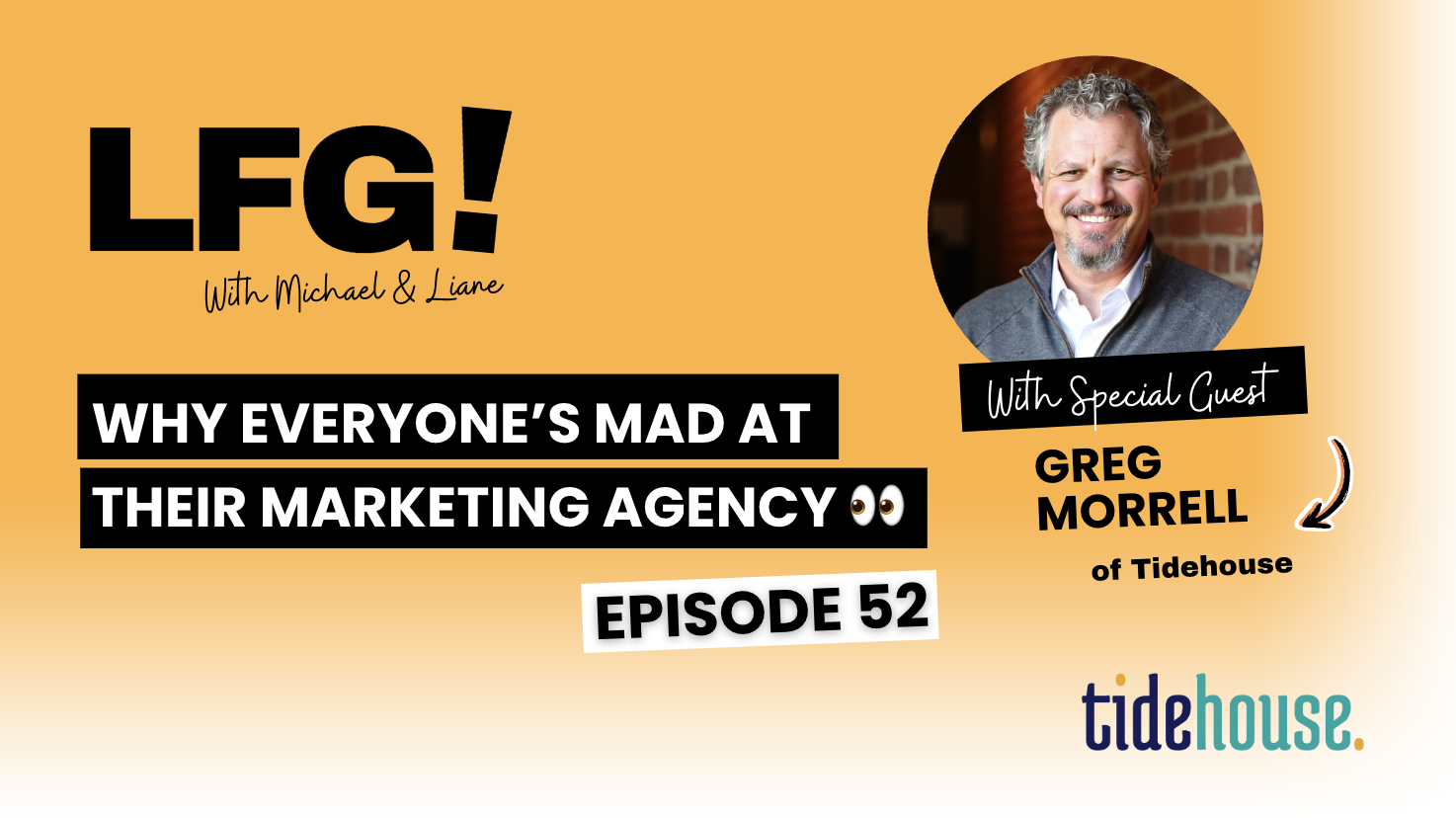
Hosts: Michael Hyam and Liane Caruso
Guest: Greg Morrell, CEO of Tidehouse
In a recent episode of The LFG Podcast with Mike & Liane, we sat down with Greg Morrell, CEO of Tidehouse, a full-service agency that has been working in franchise marketing for over 20 years.
Greg spent most of his career at digital and brand agencies before spending a dozen years as a consultant helping agencies and clients figure out how to do better work together. He joined Tidehouse a year ago specifically because he missed being in the weeds, not flying in to do what he calls “jazz hands consulting” and moving on to the next gig.
He came to this conversation ready to say some things out loud that do not get said enough in the franchise marketing space. Here is what he shared.
PODCAST SUMMARY: TIDEHOUSE CEO SHARES WHY FRANCHISE BRANDS ARE SO FRUSTRATED WITH FRANCHISE MARKETING AGENCIES
HOW FRANCHISE BRANDS ACTUALLY SEE THEIR AGENCIES RIGHT NOW
Greg did not soften the opening.
The evidence suggests that most franchise brands see their agencies as a tool in the toolbox. And if that tool is perceived as dull or wrong for the job, it gets replaced. The relationship is more vendor than partner, more transactional than collaborative.
Greg traced the causes: high pressure, tight budgets, brutal timelines, and relentless internal pressure around lead volume, lead quality, and cost per lead. In that environment, agencies have drifted toward a posture of servicing rather than advising. The playbook gets applied, the performance gets reported, and strategy gets treated as a nice-to-have or an expensive luxury that slows things down.
In Greg’s experience in his time as CEO of Tidehouse, the opposite is true. Done well and done efficiently, strategy pays dividends many times over in better work, faster time to market, and meaningfully better results.
THE AGENCY CHURN PROBLEM
One of the most striking data points Greg shared was about turnover. In his roughly 60 to 70 franchise client relationships and conversations over the past year, the rate of agency churn in this space is higher than anything he has seen in other industries.
Brands fire the agency, bring in a new one, and ask the new one to pick up right where the old one left off. Greg’s reaction to that: what is the point? If the previous approach was not working, continuing it with a different logo on the proposal is not a strategy.
The problem, as he sees it, is that brands tend to diagnose performance issues as agency problems, and the solution is to find a better agency. But when you look at the pattern, six agencies in a year is not six bad agencies. It is a signal that something deeper is broken inside the organization.
As Greg put it: at some point, you have to put a mirror up and look at the common denominator.
SYSTEMIC FRICTION: WHAT IT IS AND WHERE IT COMES FROM
The term Greg uses for what he is describing is systemic friction. It is the gap between what an agency is hired to do and what the internal structure of the client organization actually allows them to do well.
The most visible form of friction shows up in strategy workshops. When Tidehouse brings the CMO, CDO, and CEO into a room together to work through the business, Greg says you can see the misalignment in real time. The leadership team is not on the same page about what they are trying to say, who they are trying to reach, or what the priority is. And that misalignment does not stay in the room. It cascades into every brief, every campaign, and every conversation with the agency downstream.
Greg described this plainly: misalignment is cancer. It will drag the organization down and prevent good work from being possible. No agency, no matter how talented, can produce great outcomes in a consistently chaotic operating environment.
The other dimension of systemic friction is structural: how budgets are allocated, which departments talk to each other, and what each team is being held accountable for. These are organizational design problems that go well beyond what any agency can fix from the outside. But a good agency, in Greg’s view, has a responsibility to name them.
WHAT A STRATEGIC ENGAGEMENT ACTUALLY LOOKS LIKE
Tidehouse’s approach to solving for this is built around a collaborative strategy process that is deliberately different from the way most agencies present their work.
It starts before the formal engagement, often with a dinner the night before a working session: informal conversation about where things are and where the brand needs to go. From there, the team does data collection and pre-work so that everyone comes into the session prepared. But rather than presenting a strategy brief in a polished deck, Tidehouse co-creates the brief with the client on a shared whiteboard.
It is messy. It has not been spell-checked. The intention is not to impress. It is to create a learning moment, a briefing where the agency is not delivering answers but asking: is this what we understand? Is this right? What are we missing?
From that shared foundation, Tidehouse goes off for a couple of weeks and develops a thesis: given everything we discussed, here is what we think you should be saying, to whom, where, and how. That thesis gets presented not in PowerPoint but as a card exercise, laid out in a way that invites the client to push back, rearrange, and challenge the thinking.
Greg is explicit that the thesis is often wrong in some ways. That is not a failure. It is the point. The process of working through it together is what produces alignment, and alignment is what produces momentum.
When clients leave that kind of session with a shared understanding of what matters and why, the execution phase moves much faster. Within weeks, there is a new plan ready to stand up and run.
THE PARALLEL PATH
Michael asked a practical question: how much of Tidehouse’s time gets eaten up fixing existing problems versus doing the forward-looking strategic work?
Greg’s answer was that you do not get to choose. Both have to happen at once.
When Tidehouse takes on a new client, they assume ownership of the existing programs and keep things running in market while the strategic work happens in parallel. Smaller improvements get made to current campaigns right away. The bigger, more foundational changes get prioritized and sequenced so that they can be rolled out in an agile, iterative way without creating gaps in coverage.
Clients also come out of the strategic process with their own list of things to address: CRM gaps, data problems, internal process issues. The difference after going through the workshop is that they understand why those things matter and are more motivated to actually get them done.
WHAT HAPPENS WHEN IT WORKS: A REAL EXAMPLE
Michael asked for a case where alignment led to measurable results. Greg shared one without naming the brand yet, as a case study is still in progress.
The client is a multi-brand health and wellness organization, 400 units in one brand and 700 in the other. Tidehouse took them through the strategy process, which led to a significantly different messaging approach: new content, new positioning, and a new paid media program built around sharply defined personas with behavioral dimensions.
About six weeks after launch, the client had doubled the number of marketing-qualified leads coming through.
The sales team is still early in processing those leads, but early signals suggest people are also moving through the funnel more quickly. Greg was careful not to overclaim: putting new work in market takes time to fully take hold, and the real test is whether the results sustain. But doubling the quality leads at six weeks is not a small movement.
HOW TIDEHOUSE STAYS ALIGNED AFTER THE STRATEGY IS SET
The strategy session is not a one-time event. Tidehouse builds an ongoing operational rhythm around it.
Weekly check-ins focus on what got done, what did not, and what is blocking progress. Monthly reviews look at how the work is operating and how the partnership is functioning. Quarterly business reviews assess performance against the goals that came out of the strategy. The structure creates a shared cadence for learning, adjusting, and improving as the work plays out in market.
Greg framed it as an agile operations model: the strategy sets a well-formed hypothesis that the C-suite can get behind, and then the ongoing rhythm gives everyone a structured way to test and learn and pivot as new information comes in.
THE ONE THING TO DO THIS WEEK
When Liane asked Greg what a single first step looks like for a franchisor dealing with systemic friction, he did not pretend there is a simple answer. But he named one that matters: pause and look honestly at what is actually driving the performance problem.
Not pointing fingers at the agency, or the CDO, or the campaign that did not hit its numbers. Looking at the system. Asking: do we understand what is really happening here? What do we know, and what do we not know?
That kind of honest audit is harder than it sounds. It requires stepping back from the pressure, the timelines, and the bias toward whatever worked last quarter. But it is the only starting point that leads somewhere real.
Whether that audit happens with a consultant, a facilitator, an agency willing to do more than execute a playbook, or even an honest internal conversation, it matters. Because changing agencies without changing anything else is not a strategy. It is just starting the clock over.
THIS EPISODE IS BROUGHT TO YOU BY…
NetSertive, Papirfly, Franchise Assembly, and The National Franchise Show.
Listen to the full episode now to hear more from Greg, and subscribe to the LFG Podcast so you never miss an episode!
Listen on Apple, Spotify, or YouTube.
For more on Tidehouse, visit tidehouseagency.com or connect with Greg on LinkedIn. He spends several hours a week talking with people in the industry, with no agenda other than learning and sharing.

KEEP LEARNING FROM FRANCHISE ASSEMBLY

