

E50: Webinar Recap – Hidden Costs of Ignoring Upper Funnel Marketing
If you’ve ever pitched a franchisee on brand-building or upper funnel marketing spend and gotten the question “but what’s the ROI?” you’re not alone.
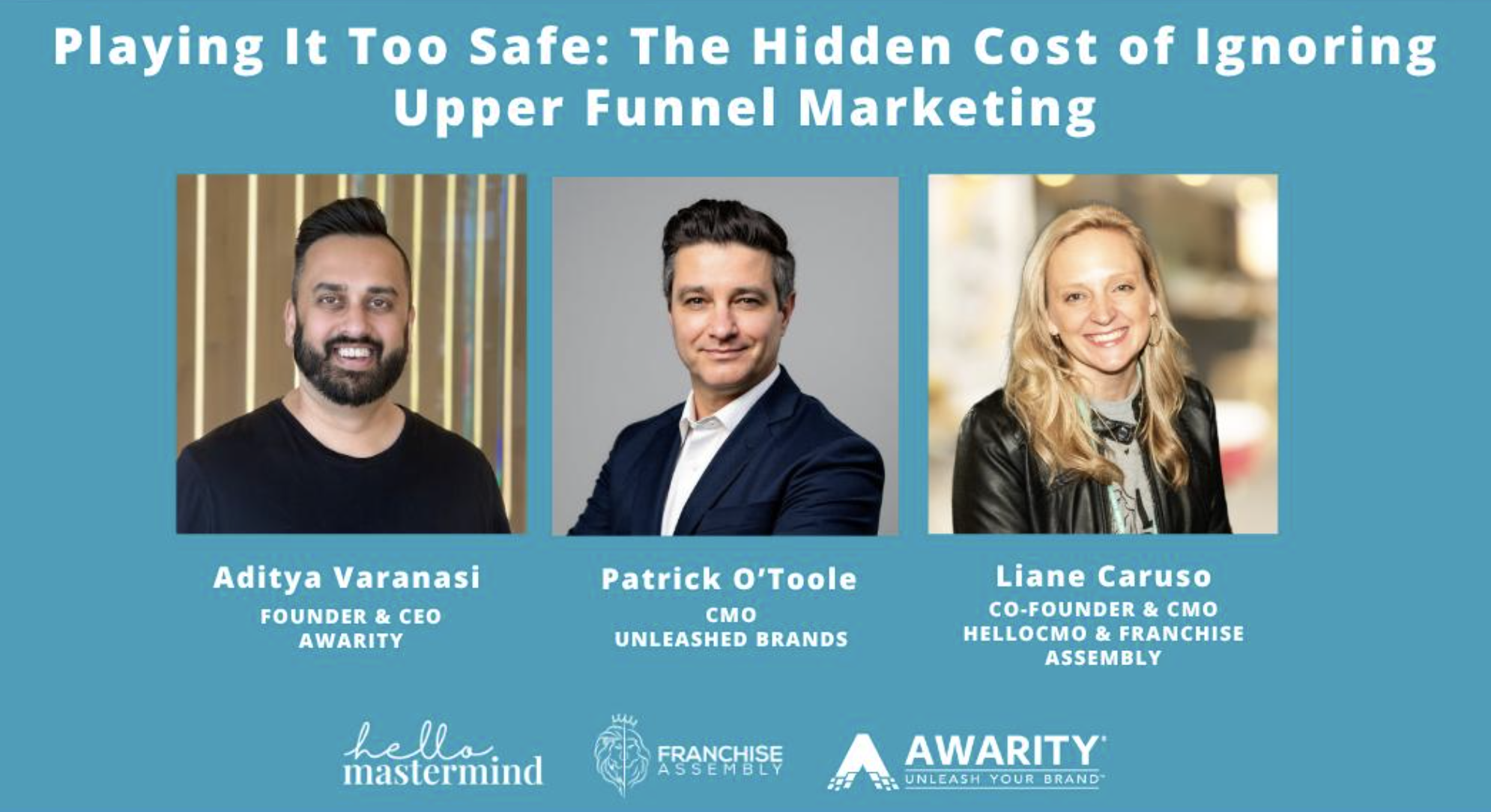
That tension between proving immediate return and investing in long-term brand demand was the centerpiece of a recent webinar featuring Liane Caruso, Founder of HelloCMO and Franchise Assembly, Aditya Varanasi, CEO & Founder of Awarity, and Pat O’Toole, CMO of Unleashed Brands.
Here are the key takeaways for franchise marketers thinking about where their next ad dollar should go.
Or, watch the webinar on YouTube.
We’ve Become Obsessed With Attribution, At a Cost
The conversation opened with a simple thought experiment: if you handed every marketer $100,000 tomorrow, how much would actually go toward creating demand versus capturing demand that already exists?
In franchising, the honest answer is usually: not much.
That’s a problem. The speakers agreed the industry has become so fixated on attribution (cost per lead, ROAS, last-click contribution) that it’s lost sight of the bigger picture.
The tools built by Google and Meta make it easy to think of advertising purely as “dollar in, two dollars out.” But as Aditya put it, if marketing were really that simple, everyone would be a billionaire by now. The reality is messier: every click and conversion represents a person on a journey, trying to figure out which brand best fits their life.
What “Upper Funnel Marketing” Actually Means
Aditya offered a useful football analogy: think of upper funnel marketing as the plays that get you into scoring position, not the goal-line plays themselves. Upper funnel marketing reaches people who aren’t ready to buy today, but seeds brand awareness and identity so that when their need finally arises, your brand is already top of mind.
This is what Aditya calls creating “shortcuts to your brand.” Ask someone what fridge brand comes to mind and they’ll likely name two or three immediately. That’s brand awareness doing its job. It doesn’t guarantee the sale (price, promotion, and in-store experience still matter), but it gets you into the consideration set. Skip that step, and even a great offer won’t convert. As Pat pointed out, a 20% discount means nothing to someone who’s never heard of your brand.
The Real-World Case for Brand Building
Pat shared a sobering example from his prior franchise experience: locations that once generated $1 million in average unit volume had fallen to $300,000. That’s not a conversion problem, it’s a brand relevance problem, and no amount of clever paid search can fix it. The fix is reinvesting in brand, knowing the results won’t show up in next month’s lead report.
At Unleashed Brands, which operates seven youth-focused brands (including Urban Air), the team has spent the last six months deliberately shifting budget toward awareness and demand generation, not abandoning lower-funnel conversion, but using upper funnel to make it work harder.
Early results, measured through media mix modeling, show improved platform return on ad spend compared to before. Aditya added that brands using upper funnel tactics have seen as much as a four-point lift in organic search metrics in territories using those tactics versus those that aren’t, a sign that brand-building drives more intent-based search down the line.
There’s No Universal Split
A natural question: what’s the “right” ratio of upper funnel to lower funnel spend? Both guests pushed back on the idea of a fixed formula. Pat noted that the right mix depends entirely on where a brand is in its lifecycle:
- A newer, low-awareness brand might need 80-90% of spend on upper funnel.
- An established brand with lines out the door on launch day might lean more toward conversion.
- The balance shifts again as competitors encroach or markets mature.
The brands that do this well, Pat said, are the ones constantly diagnosing where they are and adjusting, not locking into one ratio and walking away.
Bringing Franchisees Along for the Ride
Franchisees typically operate on tight budgets, which makes the upper-funnel conversation even harder. Both speakers emphasized that this comes down to communication and transparency: explaining clearly what each piece of ad fund spend is doing and why, rather than burying franchisees in dashboards full of metrics they don’t have context for.
Pat noted that oversharing data without explanation can actually backfire, since franchisees fixate on a single red arrow without understanding how it fits into the bigger picture.
AI Is Already Reshaping the Funnel
The conversation closed on AI’s growing role in how people discover brands. Aditya cited research showing the majority of consumers are turning to AI tools first for search, with a large share of millennials starting their search on social platforms instead of Google. As that discovery journey fragments beyond traditional search, the case for upper-funnel brand investment gets even stronger. Brands need to be part of the “consideration set” baked into AI prompts and recommendations, not just paid search results.
The speakers also pointed to rising costs across paid channels, including Google cost-per-click up 30-40% in many industries and similar increases on Meta, as another reason brands need resilience across multiple channels rather than dependence on any single platform. That includes the basics of AI readiness, like ensuring your website is structured and indexed in a way AI search tools can find and use.
The Brands That Will Win Long Term
The customer journey isn’t going away; it’s just getting more fragmented and harder to measure with last-click attribution alone. As Aditya put it, humans make emotional decisions and then rationalize them after the fact. That means the brands that win long-term will be the ones that invest in being felt and remembered, not just clicked on, long before the moment of purchase.
For franchise marketers, the takeaway isn’t to abandon lower-funnel, performance-driven tactics. It’s to stop treating them as the whole story, and start building the upper-funnel awareness that makes every one of those lower-funnel dollars work harder.

KEEP LEARNING FROM FRANCHISE ASSEMBLY

