

E49: Franchise Brand Control in the Zero-click Era! With Papirfly
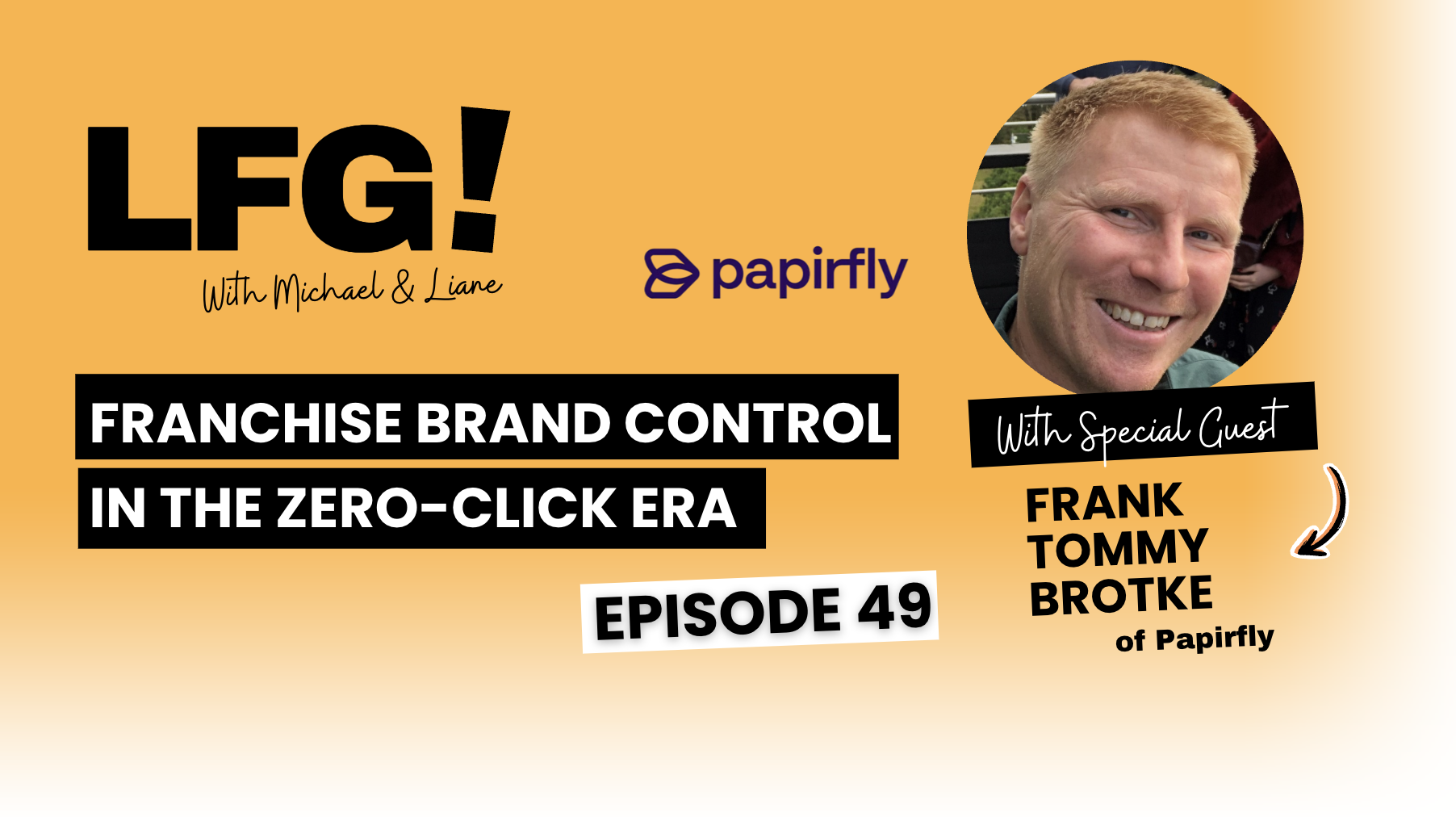
Hosts: Michael Hyam and Liane Caruso
Guest: Frank Tommy Brotke, Head of Product Marketing at Papirfly
On the June 9th episode of the LFG Podcast with Mike & Liane, we sat down with Frank Tommy Brotke, Head of Product Marketing at Papirfly. Frank joined all the way from Oslo, Norway!
Frank has spent 20 years in marketing technology, working across marketing automation, business messaging, and brand management. For the last five years, he’s been leading product marketing at Papirfly, a global brand management platform used by some of the world’s largest franchise, retail, and hospitality companies.
Papirfly is one of the show’s sponsors, and this conversation gave us a chance to go deeper on something most franchise brands are quietly struggling with: how do you maintain brand consistency across hundreds or thousands of locations in an era where AI is deciding which brands get found?
Here’s what Frank shared:
Podcast Summary: Papirfly Head of Product Marketing Shares How You Maintain Brand Consistency In The Zero-Click Era
WHAT THE ZERO-CLICK ERA MEANS FOR YOUR BRAND
Frank opened by drawing a clear line between the old way of using search engines, and the new one.
The old way: a customer thinks of going to a restaurant, opens Google, scrolls through paid listings and organic results, clicks through to a few websites, reads the menus, and decides where to go. The customer does the discovery work themselves.
The new way: the customer types a question into ChatGPT, Gemini, Claude, or another AI tool, and the AI gathers signals from across the web, synthesizes them, and serves up a recommendation. No clicking required. The AI does the discovery, interpretation, and summarizing on the customer’s behalf, and in most cases, the customer goes with whatever it surfaces.
This is the zero-click era. And as Frank put it plainly, it’s about as significant a shift as the arrival of the internet itself.
The challenge for most brands is that AI doesn’t just look at your website. It’s pulling from your social media, your Google Business Profile, your reviews on Reddit, your directory listings, and any other signal it can find. If those signals are inconsistent, unclear, or contradictory, the AI reads your brand as unclear, and unclear brands lose to clear ones.
WHY FRANCHISE BRANDS ARE MORE EXPOSED THAN CORPORATE ONES
When Michael asked why franchise organizations face greater risk in the zero-click era than traditional corporate brands, Frank’s answer was straightforward: distributed content creation at scale.
A large corporate brand controls nearly all of its output centrally. Global campaigns, paid media, social posts, and event materials. The brand team owns it, reviews it, and approves it before anything goes out. The surface area for off-brand content is small.
Franchise brands work differently. You have a central marketing team setting the standards, but then you have regional marketers, franchisees, office managers, and marketing coordinators spread across hundreds or thousands of locations, all creating content too. Frank put a number on it: if you have 1,000 stores with five employees each, that’s 5,000 people representing your brand, with varying levels of marketing expertise, limited time, and a business to run.
When those people don’t have the right tools, they improvise. They use generic design tools. They run their copy through a quick AI generator. They go rogue, not because they don’t care about the brand, but because they’re busy and they just want to serve their customers. The result, as Frank called it, is AI slop: fast, off-brand content that might save time in the short term but slowly erodes the consistency AI needs to represent your brand accurately.
THE SHORT-TERM AND LONG-TERM CONSEQUENCES
Frank broke the consequences into two buckets, and both are worth taking seriously.
Short-term: if your content is inconsistent across locations and channels, AI is less likely to surface your brand confidently. A competitor who is clear and consistent gets chosen. The customer who would have found you never does. You’re not losing a sale to a bad experience. You’re losing it before the customer ever encounters you.
Long-term: this is brand equity erosion. When your positioning is unclear across the ecosystem, your brand loses its sharpness. Over time, that dilution affects how the market perceives you, which matters enormously in situations like a private equity acquisition or a new franchisee evaluation. Buyers and prospects look at brand equity as a real asset. A fragmented, inconsistent brand signals risk.
Frank also noted something interesting from industry research: even as overall marketing budgets have been squeezed across B2B and B2C companies, investment in brand management has actually increased by roughly 10 percentage points. Companies are recognizing that consistency across the full customer journey, from awareness through loyalty, is the foundation everything else sits on.
HOW PAPIRFLY APPROACHES THE PROBLEM
Papirfly’s solution is built around three connected layers, which Frank walked through one by one.
The first is the brand portal. Rather than sending franchisees a PDF of brand guidelines and hoping for the best, Papirfly gives every local user access to a portal that presents campaigns, assets, and templates in a way that’s intuitive and motivating.
For a car dealership client, for example, the portal is framed around whichever vehicle launch is relevant in that market, because what’s selling in one country may be different from what’s selling in another. The experience is simple enough that a franchisee with no marketing background can find what they need and use it correctly.
The second layer is digital asset management: a centralized, single source of truth for every brand asset. Frank gave a sense of the scale involved here. A large e-commerce or retail company can produce up to 40,000 different media assets in a single day, across product images, campaign variations, and localized formats. Managing that volume requires a proper system.
The DAM is the backend that stores everything, from logos and people photography to product images and brand story content, so that every piece of output is drawing from the same approved, accurate library.
The third layer is intelligent templating. Every template in Papirfly is built specifically for the brand, not a generic starting point. Templates are connected to the approved asset library and can be configured to pull only the assets that are appropriate for a given region. Frank’s example here was memorable: in France, it’s illegal to park on grass. So for a car brand’s French market templates, any image of a car parked on grass is automatically excluded. Brand compliance isn’t just about colors and fonts. It’s also about local legal and cultural requirements, and Papirfly bakes that logic into the template itself.
The result, as Frank described it, is something as fast and simple as Canva, but fully on-brand and pre-approved. A franchisee can create a localized social post, an event display, an in-store sign, or a direct mail piece in about a minute, without needing to make a single brand decision.
LOCALIZATION IS MORE THAN LANGUAGE
Liane flagged a point that Frank clearly feels strongly about: localization done well goes far beyond translation.
Running your copy through Google Translate and calling it done isn’t localization. Language carries cultural nuance, and a phrase that works perfectly in English might be confusing, awkward, or even offensive in another market.
Papirfly handles this through what Frank called flexibility within a framework. Brands can pre-load approved copy variations in 10, 20, or 50 languages, written by people who understand the cultural context. Local users can also write their own copy where the brand allows it, but with approval workflows in place to ensure nothing goes out that shouldn’t.
And for a quick task, like creating a roll-up banner in 10 languages for an event, a user can create the design once and generate all 10 versions with a single click.
THE INTEGRATION PIECE
Liane also asked whether Papirfly connects to the tools franchise teams already use, including social platforms and print vendors.
Frank’s answer was yes, intentionally so. Papirfly is designed as a core part of a brand’s existing marketing technology ecosystem, not a replacement for every tool a team uses. On the digital side, content created in Papirfly can be posted directly to Facebook, LinkedIn, and other social channels through integrations.
On the print side, Papirfly works with a global print vendor network, so a marketer can design a piece in the platform and have it printed and ready for pickup in another country within a few days.
The workflow logic is built in, too. If a franchisee needs to submit something for approval before it goes to print, or if there are rules about who pays for what, that can all be configured inside the platform.
WHO PAPIRFLY IS BUILT FOR
When Liane asked directly whether Papirfly is the right fit for smaller and emerging franchise brands, Frank was refreshingly candid.
Papirfly is not built for the smallest operators. If you have five pizza locations and you’re happy where you are, it’s probably more overhead than you need. But if you’re an ambitious, growing brand with 50 stores or more, and you’re thinking about the brand infrastructure that will hold up as you scale to hundreds or thousands of locations, the conversation is worth having.
Frank’s framing: Subway had 50 stores once. Domino’s had 50 stores once. The brands that build the right systems early are the ones that scale without the brand falling apart along the way.
THE ONE PRIORITY FOR FRANCHISE BRANDS RIGHT NOW
When Liane asked Frank what a global franchise brand should focus on most right now, his answer was direct and simple: consistency.
Not a rebrand. Not a new campaign. Consistency across every touchpoint, from the global campaign to the regional marketer to the franchisee posting on social media on a Tuesday afternoon. Because AI is reading all of those signals and forming a picture of your brand. If the signals conflict, the picture is blurry. And blurry brands don’t get recommended.
Frank’s framework for getting there came down to three things: the right people (domain expertise AI can’t fully replace), the right processes (governance that works whether you’re a team of five or 50,000), and the right tools (a system that makes on-brand creation the easy option, not the hard one). Those three elements together create the foundation that everything else, including AI visibility, can be built on.
THIS EPISODE IS BROUGHT TO YOU BY…
NetSertive, Papirfly, Franchise Assembly, and The National Franchise Show.
Listen to the full episode now to hear more from Frank, and subscribe to the LFG Podcast so you never miss an episode!
Spotify: https://open.spotify.com/episode/7B7bdBC5OM3eRxCJv94Kym?si=t_iEpO6TThaAbN2PJmnayw
YouTube: https://www.youtube.com/watch?v=Rp-yG-ZJy4E
For more on Papirfly, visit papirfly.com or connect with Frank Tommy directly on LinkedIn.

KEEP LEARNING FROM FRANCHISE ASSEMBLY

