

E48: Autonomous Sales (From Call to Close) Using AI! With Raynmaker
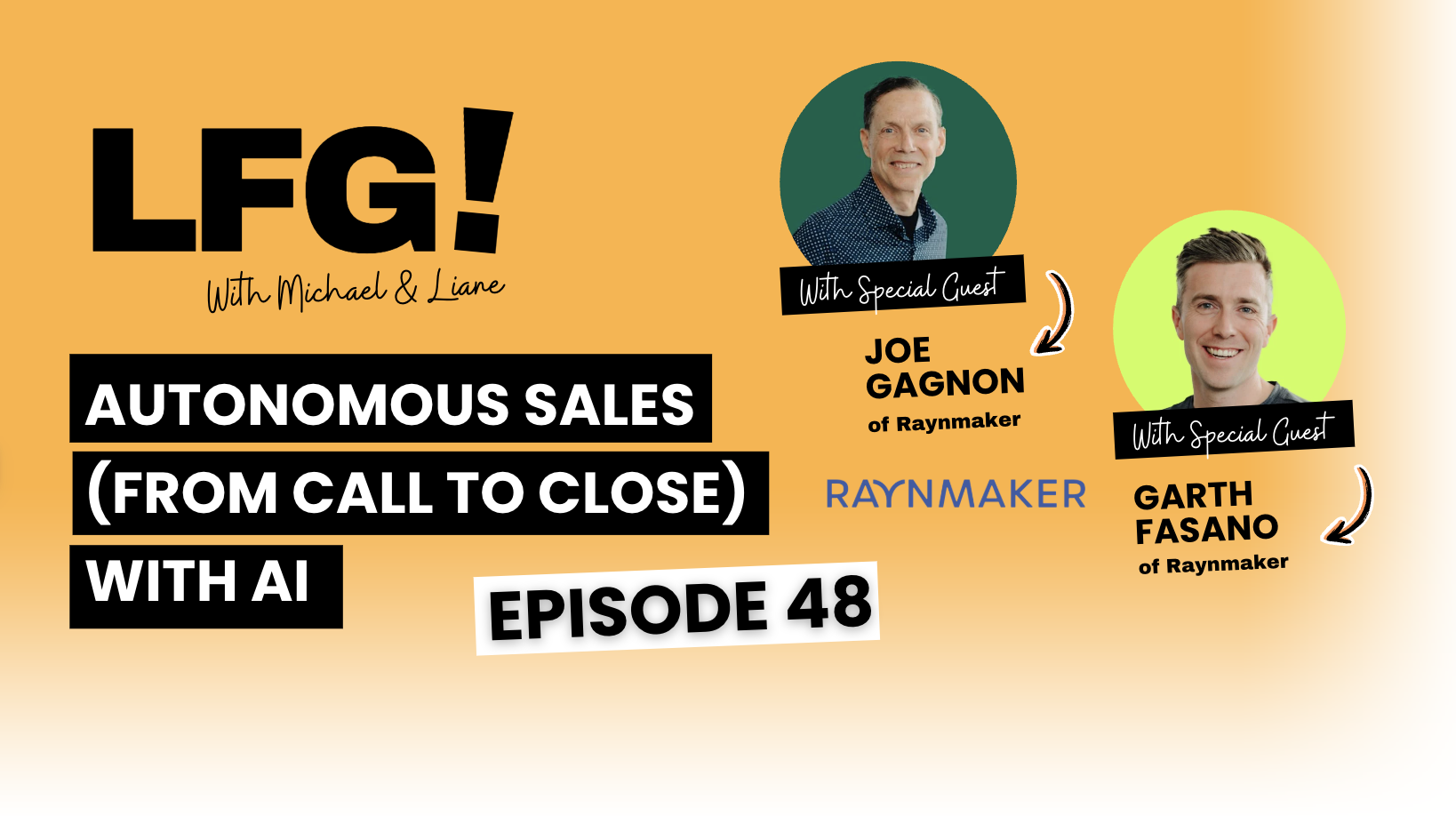
Hosts: Michael Hyam and Liane Caruso
Guests: Garth Fasano, President and Co-Founder, and Joseph Gagnon, CEO and Co-Founder of Raynmaker
This week on the LFG Podcast, we sat down with Garth Fasano and Joseph Gagnon, the co-founders behind Raynmaker, an AI-powered autonomous sales platform built for small and medium businesses.
Joe spent the early part of his career in enterprise tech, working with major organizations before spending the last 20 years building early-stage companies that transform how business processes work, primarily in the B2B2C space.
Garth’s background is in Fortune 100 sales and service consulting, where he spent two decades at the forefront of customer experience technology.
The two have worked together across multiple companies over the years. Their latest venture started with a hike at North Table Mountain in Denver, where a shared frustration with the chaos inside the small business sales process turned into a company. Here’s what they shared.
PODCAST SUMMARY: AUTONOMOUS SALES AND THE FRANCHISE OPPORTUNITY – WITH RAYNMAKER
THE PROBLEM NOBODY HAS SOLVED: WHAT HAPPENS BETWEEN LEAD AND CUSTOMER
Franchise systems are good at standardizing a lot of things. Operations. Supply chains. Brand standards. But sales? That part, despite all the training and tooling, remains stubbornly inconsistent across locations.
Joe framed it this way: it’s easy to standardize where you buy leads, and it’s easy to decide which CRM you’ll put customers into once you have them. But the messy, unpredictable part in between, the actual sales conversation, is where the system breaks down.
The reality for most franchise owners is that they’re out delivering the service, running the business, hiring people, and fielding calls whenever they can. When they or their team do get to a prospect, the quality of that interaction varies wildly. Some days it’s great. Some days the phone goes unanswered. And the franchisor has virtually no visibility into any of it.
As Joe put it: if you were asked to oversee anywhere from 2 to 1,000 locations with no direct line of sight into what was happening in those customer conversations every day, you probably wouldn’t take the job. And yet, that’s the situation most franchise systems are operating in.
WHAT AUTONOMOUS SALES ACTUALLY MEANS
When Liane asked Garth to explain autonomous sales in plain language, he got straight to the point.
The goal is to reduce the variability in your sales force. Even in a well-run operation with training, hiring, and performance management, there will always be a gap between your best and worst salespeople. You can minimize it, but you’ll never close it to zero.
Autonomous sales is about delivering a consistent experience to every customer, every time, and improving that experience over time through learning, without relying on the consistency of any individual human.
Joe was careful to clarify what autonomous doesn’t mean. It’s not about removing the feeling of humanity from the process. It’s about removing the physical limitations of a person: the fact that they can’t be on three calls at once, can’t answer the phone at midnight on a Saturday, and can’t be counted on to follow the script every single time.
What makes Raynmaker’s approach truly autonomous, in Joe’s framing, is that it combines three elements: cognitive capability (the ability to think through a conversation and adapt), empathy (the ability to read tone and emotion and respond accordingly), and workflow (a structured process that moves from interest to qualification to closed sale, including scheduling the appointment, taking a payment, and committing that data to a CRM).
The milestone that made them believe this was real: on December 17th of last year, Raynmaker closed its first fully autonomous sale with no human intervention. A 14-minute phone call. Multiple people on the line. The AI asked questions, built value, handled objections, pitched the right service at the right price, and took a deposit before booking the appointment directly onto the business’s calendar.
THE FRANCHISE INTELLIGENCE GAP
For franchisors specifically, Joe made a point that cuts to the heart of the opportunity.
Every franchisee interaction with a potential customer is a data point that currently goes unrecorded. What packages are selling? What objections keep coming up? What’s working in the Southeast that isn’t working in the Midwest? What do people think of the brand when they first call?
Right now, franchisors have no way to access that at scale. The intelligence they do have comes from transactions that roll up quarterly, at arm’s length, filtered through whatever a franchisee chooses to report.
With a platform like Raynmaker handling the sales conversation, all of that changes. Every call becomes queryable data. The franchisor can understand what’s happening in real time across the entire system, not in aggregate after the fact, but at the conversation level. And that kind of intelligence, Joe argued, is the only real defensibility a franchise system has as competition increases and margins tighten.
Garth added a concrete example from the fast casual dining space: a client who already knows they’re losing millions of dollars across their system because orders taken by phone never make it into the POS. When the call goes through Raynmaker, every transaction is captured, every order is entered, and the silent partner problem disappears.
WHAT BROKE WHEN THEY REMOVED THE HUMAN
Michael asked a sharp question: when you took the human out of the sales process, what broke, and what worked?
Garth’s honest answer was that the platform exposed something most small businesses don’t want to admit: they don’t actually have solid business rules.
When a human is handling a call, they improvise. They discount when they’re not supposed to, they take orders they can’t fulfill, they make exceptions that feel friendly in the moment but cost the business later. That flexibility seems like a feature. In practice, it’s a liability.
When Raynmaker stepped in, the business had to decide: what do we actually do in this situation? What are the rules? And for many clients, that exercise alone delivered significant value, because it forced a level of operational clarity they’d never had.
Joe gave an example from a catering demo: the platform was built with a rule that orders above a certain size couldn’t be placed within 90 minutes. When a tester tried five different ways to work around it, the AI held firm. But it wasn’t robotic about it. It offered an alternative, explained what could be done for the next day, and moved the conversation toward a result that worked for everyone. Following the rules, done well, is better customer service, not worse.
Garth added another dimension: removing that decision burden from the owner or general manager is itself a gain. The mental load of fielding every edge case, every favor request, every customer who knows the owner personally and wants a deal, is real. The platform runs the business the way the owner intended it to run, every time.
WHAT THEY’VE LEARNED ABOUT HOW CUSTOMERS ACTUALLY BUY
Listening to thousands of real customer conversations has revealed some things that don’t show up in marketing theory.
First, buying behavior varies meaningfully by vertical. A pizza order is transactional. A home services call, where someone is inviting a stranger into their house, is emotional. The process for building value and rapport is fundamentally different, and Raynmaker tailors its agents accordingly.
Second, objections are more predictable than most businesses realize. There are only so many reasons people don’t buy, and they cluster into recognizable patterns. One of the most common, across almost every home services vertical Raynmaker has worked in, is what they call the spousal objection: a customer who wants to move forward but needs to check with their partner first.
Joe’s observation was pointed: no marketing campaign has ever really addressed that objection before a customer even picks up the phone. If you know that’s coming, you could prepare the customer for the conversation before the sales call happens. That’s the feedback loop Raynmaker is building, where what’s learned in the conversation informs how you market to people before they call.
TRANSPARENCY, TRUST, AND THE RAYNMAKER CONSTITUTION
One question that comes up every time AI sales tools enter the conversation: do you tell the customer they’re talking to AI?
Joe’s answer was unambiguous: yes, always.
Raynmaker wrote a document early in their journey they call the Raynmaker Constitution, a responsibility code that governs how they put this technology between a business and its customers. They never misinform. If the AI doesn’t know something, it says so. If a customer asks whether they’re talking to AI, it answers honestly.
What they’ve found is that most people, once they experience the quality of the conversation, stay on the line. The AI offers to keep helping before transferring, and most callers take it up on that offer.
The platform is also fully configurable. Every client names their AI representative, picks a voice, sets the tone and pacing, and adjusts the content of the conversation to match their brand. Raynmaker’s favorite client story involves a business that asked for a southern accent, heard what that actually sounded like, and decided they wanted something a little more like a 30-year-old from Ohio. It took about 30 seconds to change.
WHERE RAYNMAKER IS FOCUSED NOW
Right now, Raynmaker’s primary focus is home services and food service, two spaces where inbound phone calls still matter enormously, and where the gap between what happens on the call and what gets recorded is widest.
Home services cover anything from lawn care to house cleaning to dog walking: services that are personal, require access to someone’s home, and typically involve a considered purchase. Food service includes both catering and pizza ordering, where the ask is simpler but the volume is high and the frustration of hold times and unanswered phones is a real customer experience problem.
Joe’s view on the longer horizon is broader: any business where a human is talking to another human to create a transaction is a candidate for this technology, and he expects that to include nearly every industry within the next decade.
THE ONE THING FRANCHISORS SHOULD TAKE FROM THIS
The core argument Garth and Joe are making isn’t really about AI. It’s about intelligence.
Franchise systems have always had a blind spot in the middle of their operation, the live, real-time conversations between their franchisees and potential customers. Every one of those conversations has been invisible until now. Raynmaker makes them visible, searchable, and learnable.
For franchisors who want to actually know what’s going on in their system, what’s converting and what’s not, what objections are coming up in specific markets, and where revenue is walking out the door uncaptured, the conversation with Raynmaker is worth having.
THIS EPISODE IS BROUGHT TO YOU BY…
NetSertive, Papirfly, Franchise Assembly, and The National Franchise Show.
Listen to the full episode now on Spotify, YouTube, or Apple Podcasts to hear more from Garth and Joe, and subscribe to the LFG Podcast so you never miss an episode!
For more on Raynmaker, visit raynmaker.ai, or connect with Garth and Joe on LinkedIn.

KEEP LEARNING FROM FRANCHISE ASSEMBLY

