

E47: Showing Up & Converting in the AI Marketing Era: With V Digital
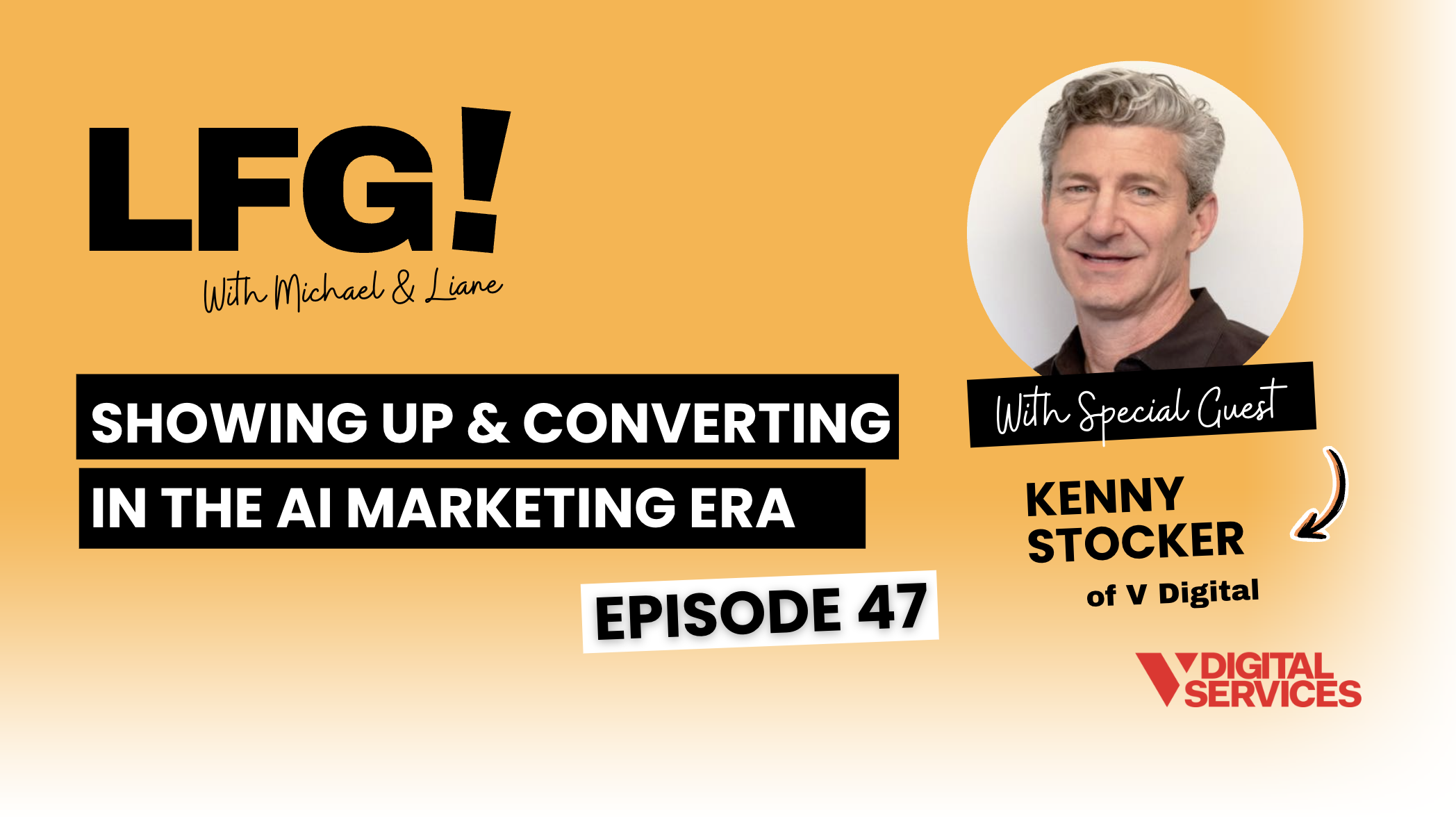
Hosts: Michael Hyam and Liane Caruso
Guest: Kenny Stocker, VP of Sales and Partnerships at V Digital Services
In a recent episode of The LFG Podcast with Mike & Liane, we sat down with Kenny Stocker, VP of Sales and Partnerships at V Digital Services.
V Digital is a full-service digital agency dedicated exclusively to national, franchise, and multi-location businesses. Kenny has been with the company for over 30 years, starting back when V Digital was one of the largest alternative newspaper publishers in the country.
He’s watched the media landscape transform from hyper-local print to hyper-local digital, and he brings that hard-won perspective to some of the most pressing questions franchise brands are grappling with today.
PODCAST SUMMARY: WINNING VISIBILITY AND FIRST-PARTY DATA IN THE AGE OF AI WITH V DIGITAL
THE AI SEARCH SHAKE-UP: WHAT’S ACTUALLY HAPPENING TO YOUR TRAFFIC
This is the conversation most franchise marketers are quietly having, and Kenny gave it some helpful context.
AI-powered search is fundamentally changing how people find businesses. Tools like ChatGPT, Claude, and Gemini are replacing the old model of Googling, clicking through a page of links, and comparing tabs.
Now, people describe what they want in natural language and expect to be handed an answer rather than a list of options. They’re planning trips, comparing service providers, and making decisions inside the AI interface without ever clicking through to a website.
The result? A phenomenon Kenny calls the “no-click problem.” Website traffic is down for a lot of brands, but conversions haven’t dropped at the same rate. Turns out, people are getting enough information from the AI summary to grab the name of a business and search for it directly, bypassing the analytics trail entirely.
The implication for franchisors is significant. Your visibility inside AI-generated results is becoming just as important as your Google ranking, and the rules for showing up there are different.
SEO IN THE AI ERA: THE THREE PILLARS STILL HOLD, WITH A TWIST
One of the most clarifying moments in the conversation came when Liane asked whether the SEO strategy had fundamentally changed, or whether it was still the same fundamentals in a new package.
Kenny’s answer: both.
The three core pillars of SEO haven’t changed.
Technical health (can search engines actually read and index your site?), content quality (does your site clearly demonstrate expertise, difference, and value?), and authority (do credible outside sources link back to your content?) are as relevant today as they were a decade ago.
What has changed is where AI looks beyond your website.
Unlike traditional Google crawlers, AI models are actively scanning Reddit threads, business directories, Better Business Bureau listings, social profiles, and Google Business Profile reviews to form a picture of your reputation. The best-funded website no longer automatically wins. The business with the richest, most authentic, most validated presence across the full digital ecosystem is the one that surfaces.
For franchise brands specifically, Kenny flagged one common structural mistake: consolidating location pages down to a single brand page to save money. It sounds efficient. But those individual local pages are exactly what AI is looking for when it tries to match a searcher to a real, community-embedded business. Cutting them costs you local visibility in ways that are hard to recover.
GOOGLE BUSINESS PROFILE: THE UNDERRATED WORKHORSE
Kenny was emphatic on this point: your Google Business Profile is not a set-it-and-forget-it asset. After a period where GBP seemed to lose steam, it’s back, because AI models have recognized that GBP pages carry some of the richest, most trustworthy local review data available.
For franchise owners who feel overwhelmed by the full scope of digital marketing, Kenny’s minimum viable recommendation is to make sure your GBP is genuinely dialed in: fresh posts, accurate service categories, complete module information, and consistent review volume.
Reviews matter more than most franchise operators realize. AI isn’t just looking for star ratings. It’s looking for the depth, recency, and specificity of what people say about your business. A location with a thousand detailed reviews is telling AI something that a slick website simply cannot.
HOW TO USE AI TO DIAGNOSE YOUR OWN SEO GAPS
One of the most practical segments of the conversation was Kenny walking through a simple, no-cost approach any franchise owner can use today.
Pull up two or three different AI tools. Ask each one: Why isn’t my Google Business Profile coming up for [your service] in [your area]? Then ask: What’s different between my website and my top competitor’s website? Which one would rank higher, and why?
The responses won’t be identical across platforms, and that’s actually useful. Different models will surface different gaps, and the overlap between them points to what matters most. From there, you have a real starting point: maybe you need more service-specific pages, more localized content, or stronger backlinks in a particular geography.
It’s not a replacement for deep keyword research and a real SEO strategy, Kenny emphasized. But for a busy owner who doesn’t know where to start, asking AI to audit your own visibility is a surprisingly effective first step.
THE LEAKY BUCKET PROBLEM: 93-95% OF YOUR VISITORS LEAVE WITHOUT CONVERTING
This is the part of the conversation that caught even the hosts off guard, and it’s where V Digital’s work gets particularly interesting.
On average, 93 to 95 percent of website visitors don’t take action on their first visit. They’re comparison shopping. They’re window shopping. They come, look around, and leave. In most cases, you have absolutely no way to reach them afterward.
V Digital’s solution to this is a product they call Prospect Hub, which is their approach to first-party data resolution. When someone visits your website, V Digital uses thousands of data partners to cross-reference signals, including IP addresses, device identifiers, and other available data points to identify who that visitor likely is: their email address, name, and other demographic data.
The key differentiator is accuracy. V Digital requires confirmation from at least five independent data sources before an email address or any identity attribute is added to a report. No single-source guesses, no junk emails.
That resolved data is then yours to use: plugged back into your Google campaigns, your Meta targeting, or your CRM for email nurture sequences.
WHY FIRST-PARTY DATA IS ESPECIALLY VALUABLE FOR FRANCHISE DEVELOPMENT
Kenny made a point that resonated strongly for the franchise audience specifically: first-party data isn’t just useful for selling services to consumers. It may be even more valuable for franchise development.
The franchise sales cycle is notoriously long. Kenny referenced a story from the LFG Let’s Grow event in Texas, where a franchisee had been in the consideration window for six years before finally signing. A deal closed from the show in LA took three years. These aren’t outliers. They’re the norm.
First-party data lets you identify people who have visited your franchise development pages, capture their information even if they didn’t fill out a form, and nurture them through a long-cadence email sequence that keeps your brand visible throughout that extended decision-making journey. Given how much budget goes into franchise development advertising, the ability to capture and re-engage that visitor traffic is a significant multiplier on existing spend.
THE EFFICIENCY GAIN IS REAL: 8-20% IMPROVEMENT IN CAMPAIGN PERFORMANCE
Kenny shared a number worth sitting with: when V Digital clients feed resolved first-party data back into their Google and Meta campaigns, they see an 8 to 20 percent improvement in campaign efficiency. The reason is simple. You’re giving the algorithms better, more specific data to optimize against, rather than relying on platforms to build targeting from scratch.
Add to that the ability to create more accurate lookalike audiences, reduce dependence on retargeting campaigns (since you already have the data), and create service-specific email drip sequences based on which pages a visitor actually looked at, and the compounding effect becomes meaningful.
ONE CRITICAL CAVEAT: HAVE A PLAN FOR YOUR DATA
Kenny’s final note of caution was an important one: first-party data is only valuable if you’re going to use it.
He’s seen brands invest in data resolution and then let it sit. The data doesn’t help anyone if it’s not being fed into campaigns, loaded into a CRM, or activated through a nurture sequence. Before you start collecting, get clear on who’s going to manage the email cadences, whether your Google or Meta campaigns are set up to ingest the data, and whether you have the internal capacity or a trusted partner to actually make it work.
As Kenny put it plainly: if you collect the data and don’t use it, it’s food spoilage.
THE ONE THING TO DO THIS WEEK
If you’re a franchisor feeling overwhelmed and not sure where to start, Kenny’s answer was direct: start with first-party data, if you’re running any campaigns at all, because it will make everything you’re already spending more effective. And then take an hour this weekend and ask an AI to compare your website against your biggest competitor’s. See what it says. Let it get your wheels turning on what you should be talking about in your next marketing meeting.
It won’t build your strategy for you. But it might show you exactly where to start.
THIS EPISODE IS BROUGHT TO YOU BY…
NetSertive, Papirfly, Franchise Assembly, and The National Franchise Show.
Listen to the full episode now on Spotify, YouTube, or Apple Podcasts to hear more from Kenny, and subscribe to the LFG Podcast so you never miss an episode!
For more on V Digital Services, visit their website or connect with Kenny directly on LinkedIn.

KEEP LEARNING FROM FRANCHISE ASSEMBLY

