

E46: Why Local Marketing Keeps Breaking Down & How to Fix It with Flint Direct
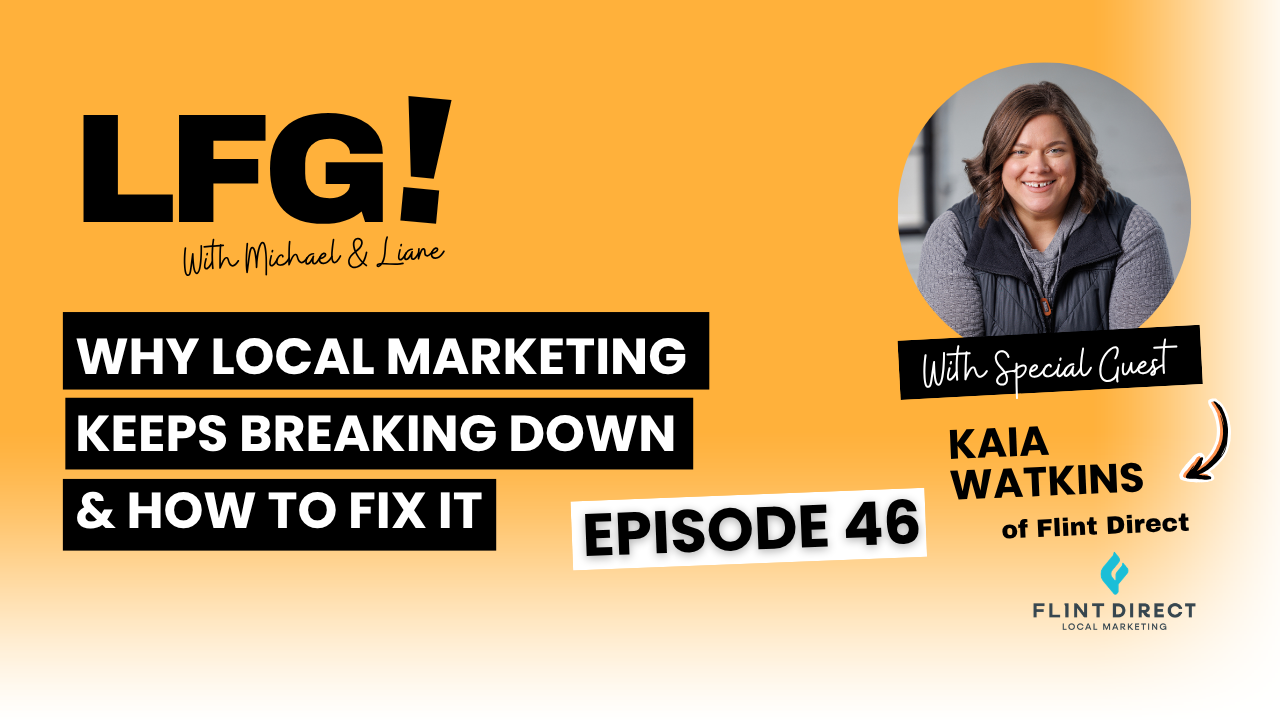
Hosts: Michael Hyam and Liane Caruso
Guest: Kaia Watkins, VP of Channel Marketing at Flint Direct
In a recent episode of The LFG Podcast with Mike & Liane, we sat down with Kaia Watkins, VP of Channel Marketing at Flint Direct — a local marketing agency that has been helping distributed brands connect authentically with local communities for over 30 years. Kaia brought 20 years of experience in creative, account management, strategy, and program development to a conversation that hits close to home for almost every franchisor: why does local marketing keep falling flat, even when the tools, budgets, and resources are all in place? Here’s what she shared.
PODCAST SUMMARY: THE LOCAL MARKETING GAP FROM FLINT DIRECT
TARGETING A ZIP CODE IS NOT A STRATEGY.
This was one of the clearest and most important points Kaia made — and it’s one that catches a lot of franchisors off guard.
Brands often believe they’re doing local marketing because they’re running geo-targeted ads, swapping in city names, or covering each location’s territory with a paid campaign. But to Kaia, that’s brand marketing at a local radius, not true local marketing.
“Just because you’re targeting around a zip code doesn’t mean you’re doing local marketing,” she said. “Every region is different. People respond differently. And people in local markets can feel that.”
The gap between brand strategy and local execution is real — and consumers can sniff it out almost immediately. When content feels corporate, when the language doesn’t match how locals actually talk about their city or neighborhood, when the business doesn’t feel like a real member of the community — it registers. And it costs.
WHY “THE CITIES” BEATS “MINNEAPOLIS-ST.PAUL” EVERY SINGLE TIME.
Kaia used a simple but memorable example to illustrate the power of authentic local language.
Everyone knows Minneapolis-St. Paul. Some people call it the Twin Cities. But if you actually live there? You call it the cities. And when a brand consistently refers to it as “Minneapolis-St. Paul” in every franchisee’s marketing, locals can immediately tell it wasn’t written by someone who lives there.
“If someone says, ‘hey, we’re the best HVAC company in the cities,’ okay — they live here, they’re real people,” Kaia explained. “It doesn’t feel like an automated spray-and-pray type of thing.”
Liane connected this directly to her own experience in Tampa: “My address says Tampa, but my section of town is New Tampa. If somebody just put Tampa in the marketing, that would feel totally off to me.” It’s a small detail that makes an enormous difference in credibility and connection.
The takeaway for franchisors: the naming conventions, the local references, and the community language you build into your marketing toolkits matter more than most HQ teams realize. And in the era of AI-generated search summaries, local relevance and terminology are only going to become more important for visibility.
WHAT AN EFFECTIVE LOCAL MARKETING PROGRAM ACTUALLY LOOKS LIKE
So what does good local marketing look like in practice? For Flint Direct, it starts with a conversation — not a template.
“First, we always sit and talk with the franchisee,” Kaia said. “We want to hear what they’ve done, what works, what their frustrations have been.” From there, Flint Direct builds a plan specific to that franchisee’s actual coverage area, competitive landscape, and community context. Every franchisee gets a unique plan — not an opt-in to a larger campaign where everyone gets the same thing.
That means localized website content, messaging and keywords tied to the specific area, and a real look at what the franchisee is doing in their community. Are they coaching Little League? Volunteering locally? Flint Direct looks for ways to tie those community connections into the marketing strategy, because that authenticity is what separates a local business from a corporate outpost.
One of the more eye-opening points: brands often spend the same dollar amount per location regardless of market size, which means they’re overspending in small rural markets and dramatically underspending in dense urban ones. Market-specific budget allocation is a simple fix that most systems haven’t made.
THE DIGITAL MIX: WHAT’S ACTUALLY WORKING LOCALLY
Kaia was candid about what works and what doesn’t when it comes to local digital marketing tactics.
The one-two punch she recommends for most locations: pay-per-click combined with Google responsive display. PPC drives direct lead volume; responsive display fills the awareness funnel above it. LSAs (Local Services Ads) can be highly effective but have been inconsistent — Google’s algorithm shifts mean what works one quarter may not work the next. Her team keeps a close eye on performance and adjusts accordingly.
Meta is a mixed bag. “It’s easy to get leads,” she said. “It’s not so easy to get them to answer a phone call or respond to an email.” Lead quality and budget mismatches are common, even when targeting is refined by household income.
The real differentiator, though, isn’t the channel — it’s the optimization. “We don’t just set it and move on,” Kaia explained. Her team stays in close contact with franchisees to understand what’s actually converting, since call tracking data often flows to the brand rather than the local operator. That feedback loop is what makes the campaigns work.
MARKETING BUDGETS: UNDERFUNDED, MISUNDERSTOOD & WHAT IT ACTUALLY TAKES
When asked in the rapid fire round whether local marketing budgets are underfunded or misunderstood, Kaia didn’t hesitate: underfunded.
Flint Direct works with franchisees spending anywhere from $1,500 to $5,000 a month at the local level, with $1,500 to $2,000 being the most common range. When someone comes in at $250? “We can’t,” she said plainly.
But the bigger issue isn’t franchisees being cheap — it’s franchisees not understanding what they’re buying. “If they don’t understand it, they’re not going to invest their money there,” Kaia said. “Whether it’s PPC, social media, SEO — if they don’t know how it’s going to help their business, it’s really hard to get them to invest.”
Liane echoed this from her own experience working with franchise brands: “When franchisees don’t spend the money and it’s not working, they say digital marketing doesn’t work. But the real issue is they didn’t spend the money.” Education comes before investment — and that’s on the brand to provide.
Flint Direct took this seriously, launching educational series for franchisees and dealer partners that produced measurable growth in their business. When franchisees understand what they’re buying, they lean in.
THE GAP NOBODY TALKS ABOUT: ACTUALLY BEING THERE FOR THE FRANCHISEE
One of the most resonant moments in the conversation came when Kaia talked about what Flint Direct sees as its most meaningful differentiator — not technology, not the channel mix, but responsiveness.
“Having a person the franchisee can call — who will respond, and not three weeks later,” she said. “Someone they can actually depend on to help solve the problem.” That might be something as small as getting into a Google Business profile, or as urgent as sales being down 20% and needing help immediately.
Liane has seen this gap consistently across the brands she works with: too many digital agencies are operating on a “turnkey without the strategy” model — franchisees are set up with tools they don’t understand, and no one is really checking in.
The best local marketing programs don’t just execute — they teach. They keep franchisees in the loop. They make sure the person investing their own money knows exactly what that investment is doing for their business.
THIS EPISODE IS BROUGHT TO YOU BY…
NetSertive, Papirfly, Franchise Assembly, and The National Franchise Show.
Listen to the full episode now to hear more from Kaia, and subscribe to the LFG Podcast so you never miss an episode!
Spotify: https://open.spotify.com/episode/53dTuGDLigqpgBC7zSiFno?si=DSMf1wosR8CKVScCmBuaJA
YouTube: https://youtu.be/v82mt-9P65M
For more on Flint Direct, visit their website or connect with Kaia on LinkedIn!

KEEP LEARNING FROM FRANCHISE ASSEMBLY

