


E44: Organic Growth Secrets (420+ Units) From The Stretch Zone Franchise
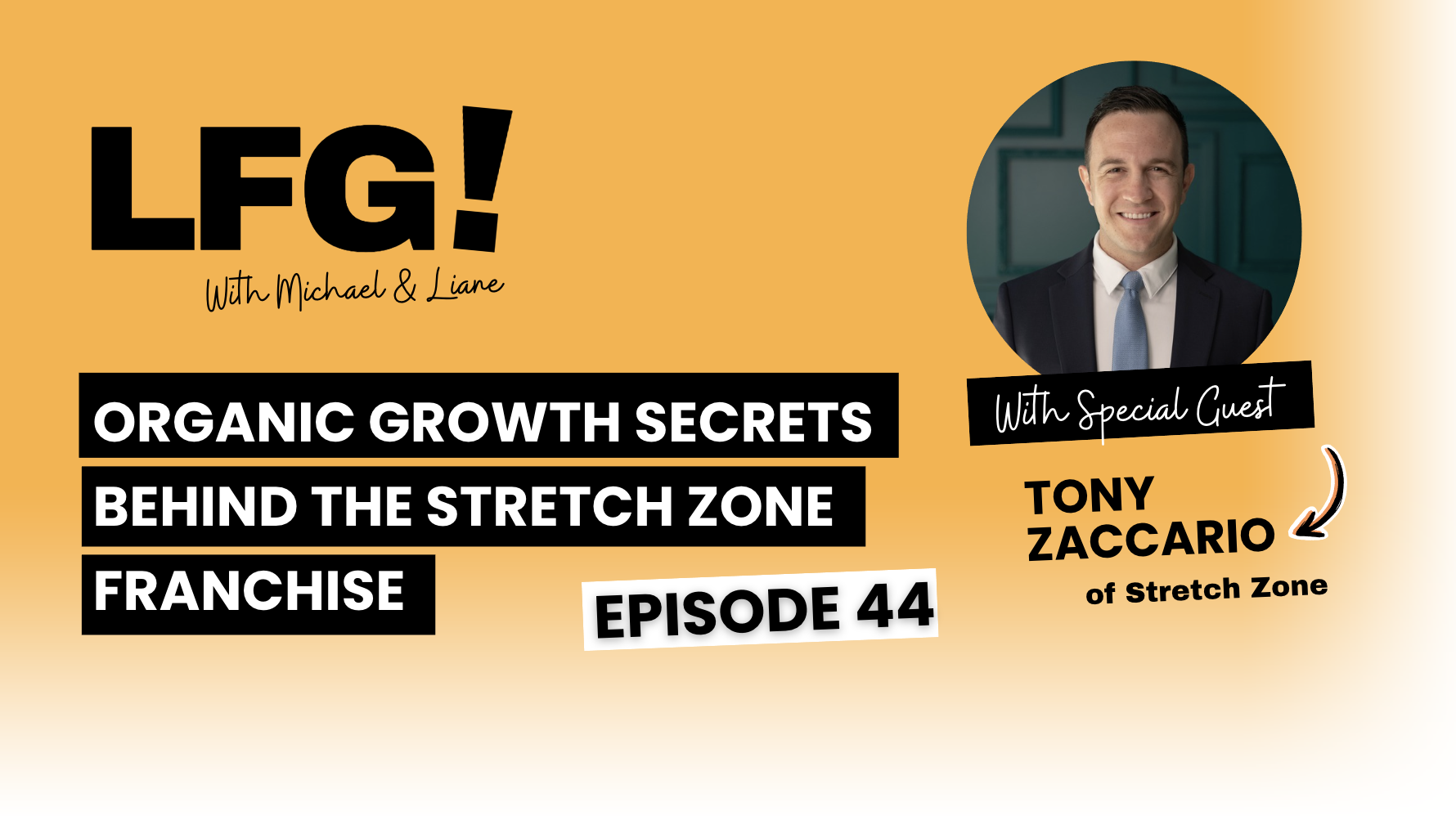
Hosts: Michael Hyam and Liane Caruso
Guests: Tony Zaccario, CEO of Stretch Zone Franchise
What happens when a founder starts stretching his bedridden grandfather just to spend time with him — and accidentally pioneers an entirely new wellness industry?
That’s the origin story of Stretch Zone, and in a recent episode of the LFG Podcast, CEO Tony Zaccario sat down with hosts Michael Hyam and Liane Caruso to share the brand’s remarkable journey, a landmark clinical research study, and the growth lessons every franchise operator should hear.
Podcast Summary: The Organic Marketing Tactics and Operational Strategies of Stretch Zone Franchise
The Origin Story: From Bedridden to Dancing at a Wedding
Stretch Zone was founded by Jordan Gold, an exercise physiologist who began experimenting with assisted stretching while working with his grandfather, who was bedridden at the time. Using a proprietary strapping system — now patented — Jordan discovered that the straps effectively acted as an extra pair of hands, enabling deeper, more effective stretches.
The results were remarkable. With regular sessions, his grandfather progressed from bedridden, to walking with a walker, to a cane, and eventually to dancing at a family wedding. That transformation became Jordan’s “aha moment,” leading him to incorporate Stretch Zone in 2004.
For years, Jordan traveled the world stretching celebrities and athletes before opening the first retail storefront in 2015. By the time Tony Zaccario joined as a partner in early 2016, the brand had just four locations — and plenty of dysfunction. No website. Hand-me-down furniture. A Groupon that Tony admits was “the worst thing ever.” But beneath the chaos was a service that was genuinely changing lives.
What Makes Stretch Zone Different
Assisted stretching isn’t entirely new — yoga instructors and personal trainers have always incorporated elements of it. But Stretch Zone is the only protocol-based assisted stretching concept on the market, and that distinction matters enormously.
Here’s what sets it apart:
A patented strapping system. The straps act as an extra pair of hands, allowing practitioners to stretch clients more effectively — especially aging or less mobile individuals who can’t easily get into certain positions on their own.
Neurological reprogramming. The Stretch Zone method works with the body’s nervous system to “reprogram” it, allowing for a deeper, more effective stretch without pain. The brand uses a 1–10 comfort scale (the “357 method”) and firmly rejects the old “no pain, no gain” mentality.
Consistency across locations. Whether you walk into a Stretch Zone in Anchorage or South Florida, you’re getting the same protocol-based stretch. That consistency is a cornerstone of brand integrity and a key differentiator from less structured competitors.
They do the work — you get the benefits. Tony jokes that it’s a service “where we do all the work and you get all the benefits.” That accessibility is central to why the brand has scaled so fast and retained such a loyal member base.
The Research Study: Putting Data Behind the Service
Perhaps the biggest news from this episode is the publication of Stretch Zone’s independent clinical study in the Journal of Musculoskeletal Disorders and Treatments — a peer-reviewed publication.
Tony explains that there were two main catalysts for commissioning the study. First, the team had years of powerful anecdotal evidence — members crying while describing how Stretch Zone changed their lives — but still struggled to convert skeptical first-timers. Second, Stretch Zone had just launched a new national accounts vertical targeting corporate wellness and industrial workplaces, and that market demands hard data.
What the study found:
- 78% of participants reported a reduction in pain, including chronic ailments
- 66% reported higher energy levels and feeling better throughout the day
- ~60% reported better sleep quality
- Those who came in multiple times per week saw 25% greater gains in range of motion and overall outcomes compared to those who came less frequently
- All findings met the threshold of statistical significance — meaning the results were not due to chance, but attributable to the Stretch Zone method itself
The study was structured with a control group and a group attending sessions twice weekly for an hour each, using both quantitative measurements (range of motion) and standardized qualitative questionnaires.
Tony notes that what surprised him most wasn’t the range-of-motion data, which was expected, but the strength and statistical validity of the qualitative outcomes — sleep, energy, and pain reduction — areas where proving causality is notoriously difficult.
The Corporate Wellness Opportunity
The study opens a significant new revenue vertical for Stretch Zone: national accounts and corporate wellness.
For industrial companies, workplace injuries that don’t meet the threshold for physical therapy still cost money in workers’ comp claims, lost productivity, and OSHA recordables. Stretch Zone positions itself as a cost-effective, preventative solution to that middle ground — helping employees manage aches and pains before they escalate.
Beyond injury prevention, Tony points to the productivity angle: if 66% of study participants report better energy and reduced end-of-day fatigue, that directly translates to more output from a workforce. “Whatever that job is,” he says, “that adds some real dollars and cents to a P&L of any kind of company.”
Now operating in 41 states with 420+ locations, Stretch Zone finally has the geographic coverage to credibly serve national accounts — something that wasn’t feasible at a smaller scale.
Franchise Growth Lessons from the Trenches
Tony’s candid reflections on how Stretch Zone scaled from 4 to 420+ locations — without a single store failure — are worth bottling for any emerging franchise brand.
1. Your best franchisee leads are inside your four walls.
Stretch Zone didn’t enter a broker network until it had 280 locations open. It didn’t run paid ads until around 200 locations. Growth was almost entirely organic, driven by members who fell in love with the service and wanted to bring it to their home markets.
Snowbirds who experienced Stretch Zone in South Florida went home to the Northeast and opened locations there. Tony’s advice to emerging brands: “Look inside your units… you’ll be surprised at how many prospective franchisees you can find there.”
2. Early adopters are your most powerful evangelists.
The first 10–20 franchisees of any concept are buying into leadership, vision, and product — not a proven track record. That passion is an asset. Lean into it before you layer on formal development infrastructure.
3. Simple beats complex.
The Stretch Zone model is built around a 1,000 sq. ft. footprint with no inventory, no waste, no spoilage, and no complex equipment. Low barrier to entry + a differentiated service = a powerful franchise proposition.
4. If you believe in your product, test it.
Tony puts it plainly: “You can’t call yourself the world’s best pizza and not enter the pizza competition.” In an era when every wellness concept claims to be the best, willingness to subject your offering to independent scientific scrutiny is itself a differentiator.
The Launch: A National Rollout in Real Time
The episode captures Stretch Zone at an exciting inflection point — mid-launch of the research study to the public. The rollout strategy is worth studying as a franchise marketing playbook:
- PR satellite media tour with brand ambassador and newly inducted NFL Hall of Famer Drew Brees
- Influencer event ahead of the public launch date
- “Unboxing party” for franchisees — a coordinated, same-night in-studio refresh with new infographics, rack cards, ceiling hangers, floor stickers, and marketing collateral telling the study story
- National referral contest to convert existing member excitement into tangible leads
- National Grand Reopening — a simultaneous ribbon cutting across all 420+ locations, reintroducing the brand to local communities
The goal is to translate scientific credibility into unit-level economics: better upsell rates on memberships, improved conversion from first-time visitors, stronger retention, and lower paid-ad lead costs.
Tony credits COO Jordan Levine and his team for a 26-city roadshow that trained 1,000+ staff members on how to integrate the new data into their daily sales and service conversations.
The Big Picture: Why Assisted Stretching Has Tailwinds
Zoom out, and Stretch Zone’s growth story reflects a broader cultural shift. An aging population that prioritizes mobility and quality of life, rising interest in preventative health, and a post-pandemic focus on wellness have all created significant tailwinds for the category.
Stretch Zone pioneered this space in 1999, has 420+ locations in 41 U.S. states and now Canada, and now has peer-reviewed clinical data to back up what its members have known for years.
For franchise investors, wellness operators, and health-conscious consumers alike, the message from Tony Zaccario is the same: the service works, the science proves it, and the best time to experience it is now.
Listen to the episode now to hear more from Tony and the LFG Podcast team!

